Tag Archives: fiction

How I Stopped Caring and I’m Better Off

So, here’s the deal. I graduated university in April. I left on a plane ten days after my last exam and travelled to South Africa and Europe for forty days. While I was abroad, I managed to secure a publishing contract after YEARS (legit, like 7 years) and then get a contract for a day job to carry me until I can *hopefully* be able to make my writing my work.

My secret? I stopped caring.
Old Life Philosophy: Micro-manage the crap out of everything and then beat yourself up when things don't go EXACTLY as planned.

Old Life Philosophy: Micro-manage the crap out of everything and then beat yourself up when things don’t go EXACTLY as planned.

Okay, backtrack. I don’t want anyone to get the wrong idea. I do care. I cared very much about getting my post-secondary degree. I cared very much about being able to uproot my life for a while and live out of a backpack. I cared and continue to care very much about my writing because ultimately, writing is my art and my child and without it, I’d be completely lost.

What I stopped caring about was all the pressure that I was putting on myself.

Before I completed my university degree, I was in a different place. I had three manuscripts that seemingly no one gave a rat’s ass about. I had the daunting task of trying to find a job in this rough and often hopeless-seeming economy. Worst of all, I had this fear welled so deep inside me that I would never get to live my dream of being a writer. I worried that I would lay on my deathbed decades from now and realize that not only had I not achieved my dream, but I had wasted my whole life with nothing to show for it. I felt hopeless.

And then I boarded a plane and everything changed, almost as soon as I landed in Paris from my first overnight flight. It wasn’t that nothing really mattered anymore because a lot of things did, it was just that I seemed to have developed a distance from everything in my life. Sure, the physical distance was there, but there was also a mental one — an emotional one.

I learned to live in the now. I stopped worrying so much about what I was going to do once I graduated, what would happen when I returned home, and how I would feel if I failed the one thing I so desperately wanted to do. I also realized the immense pressure I had been putting on myself. It was the pressure to succeed for myself and a fear that I would fail and have to live the life that society envisioned for me. I became okay with not having a clear-cut direction for a little while and best of all, I stopped caring.
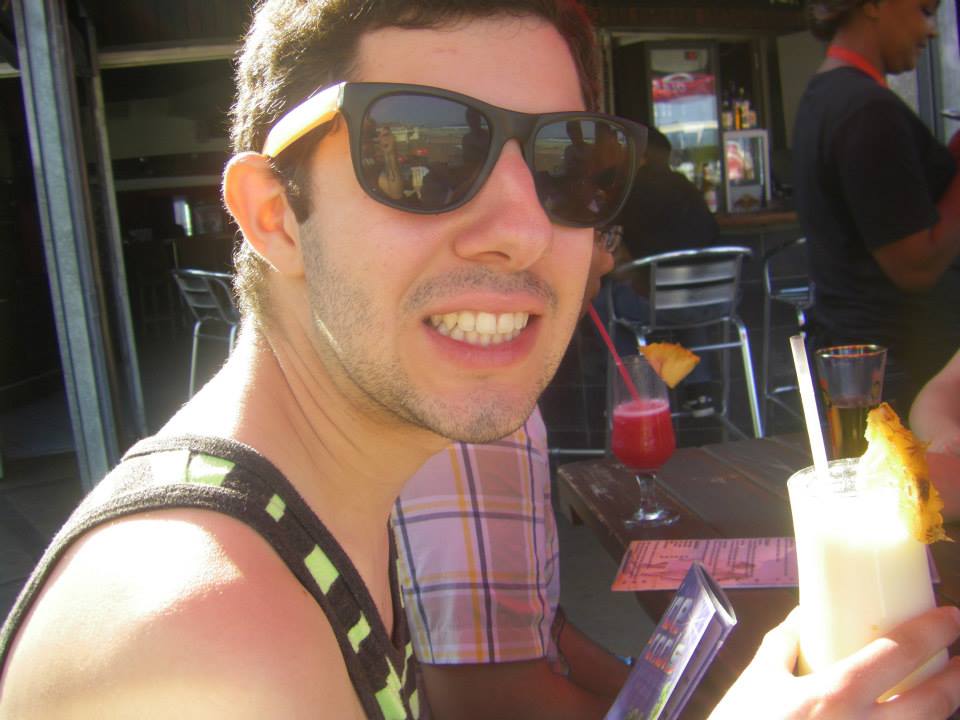
Drinking in Durban in the daytime? I just don't care!

Drinking in Durban in the daytime? I just don’t care!

I didn’t care that I had no job. I didn’t care that society was trying to convince me that my dream was unable to be achieved. I didn’t care that I had very little money and that I would return home to face an abyss with little more than a grand to my name. I just knew that I loved something so much that I trusted I would find a way to make it work.

And the moment I stopped caring and stressing, things fell into place. I was twenty-five days into my backpacking trip, checking into a hostel in Heidelberg, Germany when I got the email I would be a published author.

So, stop caring.
8 Rules for Writing Fiction and Why You Should Break Them

I always find it funny that writers and editors always seem to have a billion sometimes-contradictory dos and don’ts when it comes to writing “good” fiction. But what is “good” fiction? I don’t want to start a philosophical debate, but one person’s Shakespeare is another’s Rebecca Black, you know? So instead of giving you a list of things that I think make good writing, I’ve decided to look at the rules, whether they come from professionals or amateurs, and I’ve taken the liberty of refuting some of them.

3__It_feels_good_to_break_the_rules_gif

8. No Prologues

Listen, I can’t say I’m a particular fan of prologues, but honestly, a lot of successful writers have used them and their work has been just that: successful. I would suggest that writers stop agonizing over this rule and focus on what’s important. Get back to the writing. Get back to the story and the characters that will carry you beyond that prologue. If it’s essential to the story, it will stick.

7. No Adverbs

I read somewhere that using adverbs is a mortal sin. Mortal sin? Really? Even worse than a flawed plot line or boring characters? I militantly disagree. A couple adverbs here and there aren’t going to ruin a piece. In fact, sometimes I like them. It’s like drinking wine: a few adverbs may heighten your experience, but a lot of them can be draining and induce headaches.

Are they really that bad?

Are they really that bad?

6. Never Use A Dialogue Tag Besides “Said”

I was on this boat once, and then I got an editor and she pointed out how dry this made my writing after paragraphs and paragraphs of he said, she said. I’m not saying writers should go wild, I’m just suggesting that perhaps spicing it up a bit may actually enhance your writing.

5. No Present Tense

Don’t get me wrong: when done poorly, this can be disastrous, but mindless copies of the same old third person narrative can be terrible too. When done well, first person has an almost fast-paced, immediate feeling to it. It also feels more personal and more artistic, kind of like the primitive storytelling that humans were good at for THOUSANDS OF YEARS. So, give it a try. If it works, perhaps your story is meant to be told that way.

true-story_1413

4. Use Only Complete Sentences

If you’re writing academically, then sure. Fiction? It can have positive effects.

See what I did there?

3. Write Every Day

It’s not that I disagree with this rule, it’s just that it’s unrealistic and puts a lot of pressure on aspiring writers who ultimately fail at this and then feel inferior for not reaching this goal. Myself included. If I could rewrite this rule, I would say Write a lot.

Life happens. People have day jobs. And school. And children. And lives. If writing every day doesn’t happen, that’s okay. But don’t doubt the need for time. Writing won’t happen when you’re asleep. Just remember, sometimes quality trumps quantity. You may find that writing every day for ten minutes may not be as productive or as enjoyable as writing for 2 hours every couple days.

2. Write What you Know

I don’t necessarily disagree with this, but I disagree with the misinterpretation this rule carries. I read somewhere once that young people made for bad writers because they were too inexperienced. The argument was that young people should go out and experience the world before attempting writing. I even heard that young writers shouldn’t even try until they had a master’s degree in creative writing. In other words, young writers don’t have enough in the “know” category yet.

Pride-and-Prejudice

I say, to hell with that, write away! Forget about what you know and what you don’t. Write something that comes from the heart. 9 times out of 10, what comes from the heart isn’t just something you know, it’s what is meaningful to the soul. Besides, F. Scott Fitzgerald’s This Side of Paradise was published when he was in his twenties and he dropped out of his undergrad at Princeton without completing. That’s not to say that a writer shouldn’t explore the world around them and get new experiences, I just caution against waiting. Strike the iron while it’s hot, if you can pardon the cliché.

1. There are no Rules

There is perhaps no rule I can disagree with more. Rules are meant to be broken, yes, but that doesn’t mean that there are no rules. Writers still have to adhere to grammar and spelling rules. Failyure to do sow results in sentenses that look like this.

So, don’t listen to those who say that there are no rules. There are. Editors judge pieces based on rules. Publishers judge pieces based on rules. READERS judge pieces based on rules. What this rule means to say is that some rules can and should be broken. Others can even add an element of artistic flair if broken in the right way. Ultimately, you decide, but know that getting an opinion from an editor or trusted reader is always valuable.

Got any rules that plain just don’t make sense?

4 Things I HATE About Books

Everyone does posts and lists about how great books are, right? There’s always something like The Top 10 Books of the Summer or 100,000 Ridiculously Long Books You Should Read Before You Die, But Probably Won’t. I love those lists, but I don’t think I’d add anything original.

Instead, I’m not going to tell you what to read. In fact, I’m not even going to tell you what NOT to read (and trust me, I could name a few and save you some agony). I’ll be even more cryptic than that. I’ll tell you the 4 things that writers do that makes me want to throw their books into lawn mowers.

On nom nom, BOOKS!

1. Books that give me stage directions.

Timothy grabbed the pen and held it in his fingers. It was warm, as most pens are, and if he pressed it to the paper, it would emit the most delectable words. He held between his forefinger and his thumb and placed it to the page. He twitched his muscles in a deliberate way. He wrote a letter, curving around below the line and making a dot of smudging black.”

Do you see? This book, my friend, needs a serious copyeditor. I read a certain book like this lately, one quite popular in the YA market. It was from a trilogy about a dystopian world — maybe you’ve heard of it? Either way, if that author had cut out the mundane descriptions of everyday actions, she could’ve saved herself a hundred pages. Or two.

2. Sentences that are just too wordy.

Don’t get me wrong, I love the classics (read: adore), but these typically are the worst offenders. After a long day, the last thing I want to do is read a sentence that is longer than the book itself. I get it: spice it up, use a flowery adjective or two, wow me with your vocabulary. But invest in some periods or SOMETHING! I get to the end of your sentence and I’ve forgotten what you’ve said in the beginning.

3. Characters that can’t decide if they love each other or not.

Okay, don’t get me wrong, I like a little love story in books. In fact, I often write them into my own pieces. Love is a part of life, and it’s beautiful, and I get that. But sometimes, it makes me so angry. I just can’t stand the flip-flopping.

I love him. I hate him. He’s unreasonable. I’m unreasonable. I was wrong. But he hurt me so. He’s the worst. No, he’s not. I love him.”

Just stop. I have real life for that. A little drama is fine, but this isn’t a soap opera. The reader is not your therapist.

You aren't meant to be. We all know it. Let it go.

You aren’t meant to be. We all know it. Let it go.

4. Intellect that is out of place.

I walked into the room. She was standing there. She was pretty and I liked her.  I touched her arm and smiled. The endorphins rushed into the capillaries of my fingertips, and the serotonin in the receptors of my brain afforded me momentary contentment.”

Okay, there, Bill Nye. Tone it down. I know your writing was bland before this moment, but big words are NOT the answer. If your entire book is written that way then fine, bring it on. But don’t just add in intellectual banter to change it up. When that happens, it feels so random, like the author needs to prove to everyone that they are smart or something. We get it. Hell, you wrote an entire book. You need not prove anything!

—–

AND you know what’s even more infuriating than this list?!

When I find myself doing these things in my own writing. It makes me cringe. Don’t do it in yours. Consider yourself warned.