Tag Archives: writing advice

Filter Words, and Why it Seems You Should Kill Them All

See what I did there?

If you don’t yet know, filter words are words that writers use when they are trying to describe what a character is experiencing. For example, these sentences below could be in any piece of prose (but they aren’t cuz I wrote them):

  • Mary saw that Joe drove his car too quickly for a residential street.
  • It seemed to Mary that Joe drove recklessly, too terribly for someone who ought to know how to drive.
  • Mary heard the tires screech. Mary watched the car swerve.
  • Mary wondered if she should call the cops.
  • She realized she would have to.

So now that we know what they are, why have I decided to devote an entire blog post to them?

Let me tell you a story. First and foremost, I am a writer. It is my dream for my novels to reach readers and for me to spend all my days crafting stories and developing characters and all around having a darn good time. But none of this happens without work. A writer who doesn’t take the time to hone their craft will end up just writing for themselves (which we all say we do, but don’t lie: there’s a *little* part of us that *wants* someone else to read along).

And what has been the best thing for me to hone my craft? It’s been editing other writers’ work. I did it informally for years, and now I work in editing at a publishing house. That work is what helped me name these hideous creatures that I bolded in the examples above and determine why they are so irritating.

Back to the example of Mary and Joe who may or may not have drank a little too much or had too little sleep or may have mixed up his prescription pills by accident. You’ll be happy to know that Mary called the cops, and they caught Joe, and no one was hurt, but the real tragedy wasn’t that Joe’s car got impounded, and he has to take the bus to work. No: it’s the amount of filter words that I used to describe the situation to you.

“Why?” you ask. “What’s so bad about filter words?”

Well, if the example above didn’t already come across to you as annoying, I’d like to point out that filter words create prose that is “filtered” through the eyes of the main character. It’s like hearing something from a friend of a friend of a friend of yours. The story starts to sound passive to the reader, and it doesn’t give the immediateness that readers need to feel involved and invested in a story. Filter words almost make the prose blunted and boring and just… bleh!

Further, most of the time they are unnecessary. For example, if I write “Joe drove his car too quickly for a residential street“, does the reader lose any crucial information if we already know Mary is in her front yard trimming her rose bushes and plotting the death of the neighbor who kept her up until 4 a.m. the night before with his bombastic rap music? No. We can assume that Mary notices Joe’s unsafe driving just by virtue of knowing that she’s outside.

So, can you ever use filter words? Short answer: yes. Sometimes filter words can be essential to a scene or a sentence. Filter words only become a problem when they are part of every sentence. Maybe it’s because I edit professionally now, but I find that too many filter words make me cringe. And you’d be surprised how many get used in any given manuscript. You’d be surprised at how many I found in “The Black Oracle” prior to publication.

Do a ctrl +f in your WIP and look for these words NOW:

  • to see
  • to hear
  • to wonder
  • to realize
  • to watch
  • to look
  • to seem
  • to feel (or feel like)
  • can or to be able to
  • to decide
  • to sound (or sound like)
  • to notice
  • to experience

To finish: filter words should be to prose as garlic is to cooking. A delicate sprinkle is all that’s needed because too much will leave a sour taste in your reader’s mouth and have them wishing they’d bought something else off of Amazon.

How many filter words do you use in your work?
The 7 WORST Cliches in Young Adult Fiction

Also check out the 8 WORST Cliches in Fiction. Because cliches are everywhere, and acknowledging that we have a problem is the first step to recovery.

I’m going to start off by saying I love Young Adult fiction. I grew up on Young Adult fiction, and I still read Young Adult Fiction (yes, I know I am a grown man, but I make my own money now, so I do what I want).

However, there are certain things about Young Adult fiction I just can’t stand. Yes, I understand there is an unofficial formula. Yes, I know there are things every Young Adult novel MUST do. And yes, I know *not* adhering to certain expectations will cast your novel into the world of unsold oblivion.

But, seriously. There are some things that just. gotta. GO!

“I Love Him. I Hate Him.”

Okay, listen, this isn’t high school. Except… yes, it is.

The point is, we get it. Being a teenager is tough. Your hormones are out of control, you’re feeling things you’ve never felt before, you probably smell, but you won’t realize you smelled until you reach twenty and get a whiff of teenagers.

I digress.

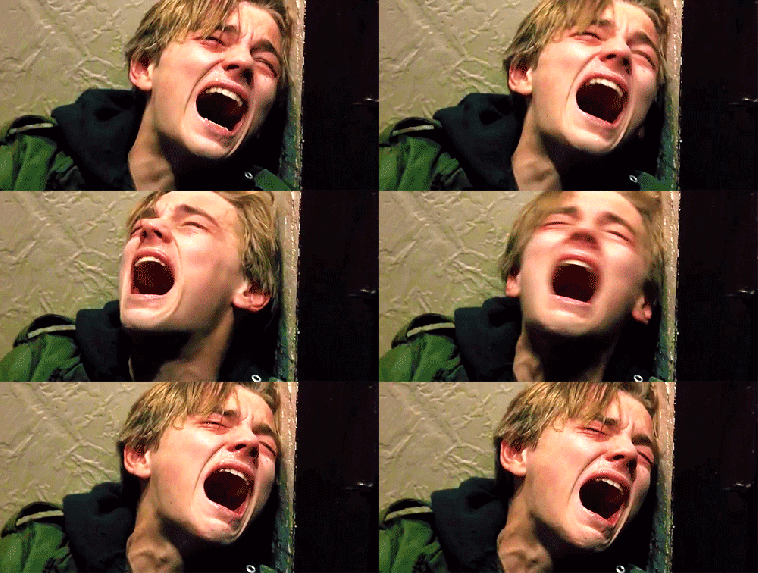
Relationship drama was and is the most annoying part of high school, was it not? Two people who love each other but don’t love each other and then decide they can’t be together for whatever reason but then get back together anyway because they can’t stand being apart.

crying-screaming-sobbing-guy-gif-first-world-problems

Just stop. It’s done. We all lived high school. We don’t need any more YA lit to recount those experiences. Write about something else.

Related: The Love Triangle

Team Edward or Team Jacob? Team Gale or Team Peeta?

How about Team Stop-It-Already! I understand love triangles make things interesting. I understand from a marketing perspective it’s a good way to polarize readers, fuel passionate discussion, and ultimately get hype about a book. But it’s old now. It’s overused and boring.

anigif_enhanced-buzz-10113-1382948371-0

In fact, trash stereotypical love altogether. I want to read a YA novel that *doesn’t* focus on it for once.

It’s the End of the World!

This one is ironic for me, isn’t it? Yes, my novel “The Black Oracle” takes place *after* the end of the world, but no: it is not *about* the end of the world.

In any case, dystopias are getting a little out of hand. And I love dystopian literature which is why I’m particularly against this cliche. It’s like they’ve taken the same story over and over again and recycled it for more $$, and that’s a terrible reason to write a dystopian novel (or three. See below).

angry-dwight

So, I revise: dystopias aren’t the worst. They’re actually pretty awesome. We just need something new every once in a while. Or for at least the next ten years.

Related: REBELLION!

The worst cliche within the cliche of YA dystopia (cliche-ception?) is the fact that main characters have to rebel against the dystopian society they’re living in. When it was done in the Hunger Games, it was pretty cool. And then it kept happening, again and again like a bad cold that keeps returning.

tumblr_inline_nnbzvfUOQX1rsoel3_500

And the whole “reluctant hero” thing? Ugh. I’m sick of main characters who are tossed into a rebellion and the whole time they’re like “but what if I can’t be a good rebel? Waahh”. Well, move over then. Let a passionate character who actually wants to overhaul society be there.

First Person, Present Tense

I walk into the room and pick up the book on my nightstand. The cover is glossy, the words protruding from the page like uneven pavement. I open the book and glance at the first page. I release the breath I didn’t know I was holding. Oh no, I think, not another one.

The novel is in first person, present tense.

screaming

You wanna know what my biggest qualm with first person, present tense is? Besides the fact that it is terribly limiting, and it generally makes me detest main characters, it is also horribly contrived. Who *actually* speaks or thinks in the way main characters in first person, present tense main characters do? Do teenagers really think in metaphor? Do they play around with sentence structure and randomly use enormous words to demonstrate their authoritative command of English prose?

No. No, they don’t. Write in third person already, and I won’t spend the entire novel thinking about how unrealistic a character is.

The Trilogy of Three Books that Could Have Been Better as One

The title says it all. If I find out a YA novel is part of a trilogy, I’m turned off. I see the appeal (mainly because it drives people to buy more than one novel), but good things don’t always come in threes. Why stretch out the plot over three novels and fill space with drivel when a writer can compose one single awesome novel?

68ea9a69dba3765d4caf78d371babf51

In fact, I wrote about this at a length in another blog post. I feel like there’s a pressure in the industry for authors and prospective authors to write three novels, and I don’t think it’s right. I believe in writing a trilogy because an idea is too long or too all-encompassing to cram into one novel. Don’t stretch it out for the sake of making more money. While we’re at it, stop dividing final movie adaptations into this part one, part two bullcrap!

The Hunky Male is Hunky… and Also Magical

Maybe it’s because I’m a guy, but I just don’t get it. Sure, hunky men are fine, and they get readers all hot and bothered, but why do they need to have magical powers or be super sexy aliens from the planet Frion sent here to make human girls squeal?

It’s just annoying. And a little condescending. Is a man not attractive unless he’s got magic powers? Isn’t that an odd commentary about the state of male-female relationships?

You know what? It doesn’t matter. Just make the love interest normal or write him out completely.

Jack-Nicholson

What are your least favorite cliches in YA books?

5 Tips to Writing a Successful First Draft (Even if it Sucks)

To date, I’ve completed 4.5 first drafts. I say 4.5 because I have 4 manuscripts of novels that are at various points of editing and publishing, but I also have a fifth manuscript, a contemporary YA that’s on vacation. I say vacation because it’s nicer than saying on hiatus or abandoned or acknowledging that I *may* not be ready to complete it yet.

In any case, writing a first draft is a complicated and emotional process. It’s complicated because you don’t know what you’ll end up with once you start. It’s emotional because of how invested you become: in the story, in the characters, in the frustration that the “art” you’re creating may be nothing more than a carefully-crafted piece of crap.

But worry not: all great literature had to start off as crud. In fact, all those bestsellers you admire yet secretly envy on your bookshelf were probably rejected multiple times.

So check out these 5 tips for completing your heap of crap!

Plan — Or Don’t!

Some writers are planners. Some writers are not. I am a hybrid of the two: I start off by letting things just happen, and then I start to outline, flesh out characters, and plan scenes. I’m a like a liger, if you will. Magic and all.

liger-2

It’s up to each writer to determine what works best for them. Planning can help focus a story, but it can also sap it dry of all its intrigue and leave the writer uninspired to get it finished. I find that when I plan too intensely or too early, this happens to me. Remember that vacation my .5 was on? Yeah… I planned too early. It’s like all the magic is gone, and writing it feels like homework. When that happens, it’s best I back away for some time.

But some writers are the opposite. If they have no plan, they have nothing to hold them to their goal of writing a novel. There are a number of methods out there including chapter-by-chapter breakdowns, pre-completion synopsis writing, and the Snowflake MethodChuck Wendig has a great list of methods to plan your novel.

Don’t Edit

Seriously. DON’T. Put down your red pen. Editing is the kryptonite of writing a first draft. I never do it unless I want to end up in the oblivion of perfection-seeking and aimless toiling. The number one way to self-sabotage your work is by primping and probing too soon. It’s like taking a baby out of their crib, plopping them in the driver seat of a car, and expecting them to win the Indy 500. It will be disastrous simply because they’re not ready.

The same is true for your novel. Your first draft is the infancy of your novel, and should you helicopter-parent too soon, you will experience an adolescence of bad attitude, screaming matches, and underage drinking. You need to give your first draft some space to breathe. Allow yourself to be creative and get your ideas down before you start picking and pulling it apart.

Just Keep Swimming

When it comes to writing a first draft, perseverance is key. It’s easy to entertain an idea, to write the first ten pages of a piece, to daydream about characters and betrayals and plot twists. Heck, it’s fun even! But when the novelty wears off, the only thing that will see you through the middle-manuscript blahs will be your determination to get that sucker finished.

For me, weekly writing goals work. Do I always stick to them? Haha… no. This last week alone I had a writing goal of 2500, and I only made 1600. But, you see, even though I didn’t make my writing goal, I still wrote. I still persevered. I am still determined to complete my manuscript. In fact, my writing goals are more like guidelines. 1600 words is better than none at all, and if I make even half my goal of 2500 words this week, that is 3000 words closer to a completed first draft.

Allow Yourself to Suck

You suck. I suck. Everyone sucks.

Seriously, the first draft sucks. There’s no getting around it. There’s no way to sacrifice a lamb to the demi-gods of the Sahara and write a perfect first draft (but if there is, hook a brother up!). So come to terms with it. Digest it, and make it part of your writing routine. Allow yourself to suck, and writing your first draft will go smoother, I promise.

In fact, once you liberate yourself, you may find that you don’t suck as much as you feared after all.

Expect to Rewrite

If you haven’t realized this by now, I’m sorry to break this to you: your first draft is NEVER the one you show the world. Wallow in self-pity now, aspiring writer, because if you want this, you’re in for the long haul. Even if you manage to nab an agent or an editor off of your first draft alone, they will insist you edit. In fact, my first novel has gone through 12 edits, and it hasn’t even been released yet.

But this isn’t a terrible thing. Your first draft is crap, remember? The only way to make it into gold is by editing. Essentially, the first draft is only half of the task of writing. Editing is where you get to show the reader your storytelling prowess and wow them with your spit-shined, immaculately-constructed prose.

How do you get through a first draft?

9 Tips to Improve Your Writing

One of the hardest things about being a writer is knowing when you’ve reached that elusive status of being a good writer. Scratch that: the hardest thing about being a writer is knowing when you no longer suck.

You see, bad writing is everywhere nowadays. With the exploding self-publishing industry, anyone can become a published author. Anyone. Have good books been self-published? Of course, but bad books have been published tenfold, and this excludes all the times that a big press has released a poorly written book (in the name of business, of course).

So, how do you avoid being a bad writer? Well, the answer is simple: hard work. And while you’re at it, pounding away at your keyboard and going for that eighth cup of coffee, incorporate these tips.

coffee

Yeah, I’d go put the pot back on. You might be here a while.

Write Often and Diversify

A writer who doesn’t write is a person who is just… well, a person. To be a writer, you must write. Yes, that means you must sit down with notebook and pen, keyboard and screen, arm and permanent market, and create something. But you mustn’t only strive to write as often as you can. You should experiment with differently genres and mediums to see what works best for you. If you’re a poet, try a short story. If you’re a novelist, try articles or essays. There are so many ways writers can practice and hone their craft (freelance writing, blogs, social media), and there’s a seemingly endless stream of topics to write about.

Read. EVERYTHING.

Just because you’re a science fiction writer, it doesn’t mean you should only read science fiction. Just because your a short story guru, it doesn’t mean you shouldn’t pick up poetry. You should read things you would never think to read, and the classics of each medium are a must. Don’t only stick forget nonfiction and media though. Read newspapers, online journalism, blogs, the backs of cereal boxes. The more you immerse yourself in writing, the more natural it becomes — and the mind has a way of imitating things it likes.

Subscribe to a Style Guide

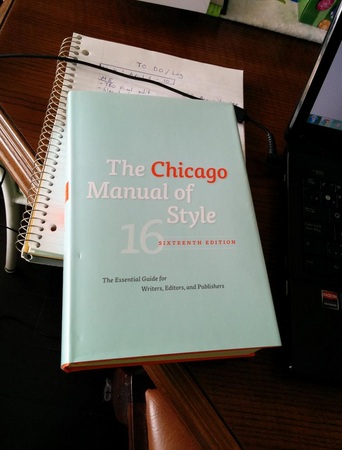
I know, I know. Why would you want to buy something that reads like a grammar textbook? Yes, I’m aware that writing is an art, but you also must realize that this art has rules. Buying a style guide is a way of learning about those rules. I like the Chicago Manual of Style, mainly because it is the predominant style guide in North America, but there are loads of others. If it is your dream to write professionally, whether it be fiction, freelance, or nonfiction, you should get yourself  style guide. Regardless of which guide you subscribe to, the key is to be consistent.

Look at how pretty it is!

Look at how pretty it is!

Use Prompts and Exercises

I’m not big into writing prompts, but I do admit, they’ve gotten me a few cool ideas. Do a quick Google search, and you’ll see that there are hundreds, nay, THOUSANDS of prompts to get you in the mood (not that mood). I’m all about those writing exercises though. Whenever I’m trying to get a new idea, I love a good free write. Whenever I’m trying to flesh that idea out, I make mind maps and pretend conversations with my characters. Exercises and prompts are also good ways to counter that writer’s block.

Focus on Openers

There’s a reason why openers are called hooks. The purpose of the opener is to entice your reader, pull them in, and then trap them so they won’t think to run until it’s far too late. From my experience as an Acquisitions Editor, I reject a lot of work because of weak openers. Put simply: I reject things I’m not excited to continue reading. It doesn’t matter if your middle is spit-shined, bacon-wrapped, chocolate-dipped literary gold. No one will get to it if you don’t give them a reason to hang around.

Do Things that Inspire You

Sitting around the house all day won’t inspire you enough to be excited about your writing. Well, it might, but you might also find you need something more. Travel, discover your city, visit museums and art galleries and after hours nightclubs (creeper protection not included). Don’t be afraid to do things out of your normal because it’s in these situations where we grow. Besides, new experiences are always great sources for writing material.

Find a Friend

Writers need criticism. Do they always want it? No, but after a while, a writer realizes that the best way to grow is to embrace criticism and STOP writing it off as useless hatred (haha, see what I did there?). I’m serious. Go find a writing partner, ideally someone who reads a lot and perhaps writes quite a bit too. Most importantly, you want this person to be honest with you. You want them to give you notes about what they don’t like and what needs to change, and you need to TAKE THEIR CRITICISM AND USE IT. Is all of it useful? No. Some of it, you may veto (I’ve done so from time to time). But if you’re ignoring 95% of all the criticism you receive, the problem *may* not be your writing partner.

Edit Ruthlessly

Whether you have a writing partner or not, a first draft is NEVER an acceptable manuscript. You should cut things. You should add things. You should eliminate all cliches, most adverbs, and flowery prose from your work. Once you think you’re done, take some space. Give yourself a week or two, and return to hack away some more. It’s not over until you’ve mistakenly cut off a limb.

Wait, you’re not done. Remember the style guide we spoke about? Go read it. Brush up on your grammar, go back, and copy edit the crap out of your work.

Don’t Try So Hard

My final piece of advice is quite simple: don’t try so hard. Revel in the simplicity. Be concise, and say what you mean. I’m sorry to tell you, you will not be another Hemingway. Before you sulk, you will not be another Hemingway because there is only ONE Hemingway (and spoiler alert: he’s dead). But you’re you! Isn’t that enough? Take pointers from the greats, but don’t steal their style. Yours may still be a ways away, but it’ll come.

But leave out those damn adverbs.

Why Write?

So, I read an interesting blog post yesterday by the fantastic Kristen Lamb (follow her. NOW!), and she addressed the idea that only 5% of prospective writers *actually* become successful authors. In her post, she argued that although this is a depressing statistic for those of us who aspire to be that elusive successful writer, 5% isn’t that bad. Check out her reasoning:

When I gave the 5% statistic earlier, many of you were probably discouraged. But let’s take a closer look at that number.

It’s been said that as much as 75% of the literate population would love to one day write a book. Out of hundreds of millions of possible authors, how many do you think actually take the idea seriously?

5%

And of the tens of millions left over, how many sit down and write and finish a first draft?

5%

Of the millions remaining, how many actually read craft books, get critique and keep revising that first draft until they have a polished draft?

5%

Of those who finish that first novel then realize they have a train wreck and not a novel, how many suck it up and start over to write a better book that’s more likely to engage with readers?

5%

Of those who finally write a decent book, how many take time to also build a brand and platform? How many learn to blog effectively in ways that reach and cultivate readers?

5%

How many get in the regular habit of writing, researching and revising? They don’t just stop with the one book and keep on writing more books?

5%

Of those who publish the first book and don’t instantly become zillionaires, how many keep writing and improving?

5%

This profession is really hard. Toss a few hundred million people with a dream into one large funnel and most will not shake out at the end. Yet, if we look at the individual pieces of becoming “successful” it is astonishing how much we control.

Others whine, we work.

At this point of my life, I found this to be pretty inspiring. I recently left my 9-to-5 (read: my contract didn’t get extended), and though I wasn’t completely against going out and finding another one, I’m *kinda* inspired to give this full-time writer thing a try. So, that’s what I’ve pledged to do. I have my novel coming out next month, and I’m working to secure some freelance work. Is this plan risky? Of course. Am I worried? Not really.

In light of these things, Kristen Lamb’s reasoning got me thinking. Yes, 5% may not be so bad when you consider that a lot of unsuccessful writers  are unsuccessful because they don’t put in the time, but the amount of commitment expected of a writer is nothing to laugh at. In fact, becoming a writer is often fruitless labor for the first while (10 years in my case), so with that seemingly unattainable dedication, why write at all?

I think the answer to that question is fairly simple. Anybody who is serious about writing already knows that answer, and I think it is those people who end up persevering and becoming the perceived unattainable successful writer. The fact is that writers write because they have to. They write because there isn’t anything else they’d rather be doing. They were “born this way”, so to speak (Thanks GaGa). And at the end of the day, a writer becomes one of the “lucky” 5% not because of luck at all but because they wanted to, and they worked their butt off to get there. I’ve always said that becoming a writer is like running a marathon: you don’t just wake up one day, show up at the starting line, and come in first place. There’s training. There’s failure. There are nasty blisters and early mornings and vomiting from overexertion (beautiful visual, Michael).

But writers like it this way. If becoming a successful writer were easy, it wouldn’t be worth it. How fulfilling would it be if you could just laser beam 80,000 words onto a computer screen and then sell it to the first publisher you pitched it to? Not very.

So, take comfort in the fact that determination does great things. Work your butt off, but enjoy the process. It’s not until years later that you appreciate all the time it took you to grow. Trust me, reading old material has become a nice pastime for me. It’s kind of inspiring.

Why do you write? Do you worry about becoming a successful writer?

5 Ways of Balancing Your Writerly Life

One of the biggest challenges I have as a writer has very little to with writing and very much to do with time and motivation. After spending eight hours at a 9-to-5, writing often gets left out of the weekday equation, especially when other commitments like personal upkeep, maintaining relationships, and sleep also demand attention. And even when a writer gets around to the half-hour of writing time, it almost never pans out the way we want it too, too commonly fraught with distraction, pressure, and a lack of motivation.

But never fear! Some tips for balancing your writerly life are here!

Welp, I may be able to squeeze in some writing time at 4 am next Tuesday.

Welp, I may be able to squeeze in some writing time at 4 am next Tuesday.

1. Make Time to Write

Seems simple enough… Yet, for me, it’s the single hardest thing to do. I find that unless I actually set aside time to get to my computer and work on something, I won’t. It’s not that I don’t want to do it, because I really do love what I do, it’s that time slips away easily when we’re busiest. In fact, sometimes I go a couple days without doing any writing at all, and yet it feels like no time has passed.

In between all that homework, 9-to-5 work, socializing, exercising, cleaning, laundry, cooking, driving, and sleeping, it is essential to take a chunk of time and dedicate it to writing. Some writers and bloggers stress that this should be every day, but I don’t know what world they live in. I would aim for at least an hour or more every couple days. And put that in your calendar (or as an alarm on your phone). If you make yourself obligated to get up every morning, sit in traffic, and go to work, then make yourself obligated to doing something you love.

2. Make Time to Relax

There’s nothing more annoying than sitting down for a writing session and discovering that you’re just too damn tired, jaded, and agitated to be productive. And to make matters worse, I instantly get more agitated when I’ve set aside time to write and I just don’t feel like doing it.

For me, writing it not just a hobby and potential job. Writing is a state of mind. And frankly, it’s hard to tap into that state of mind after frantically buzzing around an office all day, sitting in traffic, and then balancing the responsibilities of being a semi-functional-but-trying adult. To counter this anti-inspiration lifestyle, I generally take a half hour before a writing session to set the mood, so to speak. I’ll do some reading, turn off the technology, and sometimes listen to some music to set the tone. I find this allows me to approach my writing with a clear head instead of trying to combat all the other fleeting thoughts while I’m trying to focus.

3. Remove the Pressure

This ties into my previous piece of advice. I like to call this performance anxiety. I spend all day telling myself that I’m going to write and I’m excited to do so and then I build it up and before I know it, I’ve committed myself to churning out 3,000 words in the 25 minutes I’ve allotted to writing. And then when I fail, I feel guilty and angry with myself.

Take away the expectations and attempt to write in a stress-free manner. I would even go so far as to not worry about a word count. Instead of setting yourself a requirement to write 1,000 words in a given sitting, try just writing any amount of words at all. Lowering your expectations leads to no disappointment and a healthier pro-writing mindset. You might even be surprised at how productive you can be if you allow yourself the freedom of no word count.

I don't care how cute you are. You're distracting me!

I don’t care how cute you are. You’re distracting me!

4. Cut the Distractions

That means Facebook. And Twitter. And the 100,000 fail videos on YouTube. While you’re at it, tell those around you that you’re taking the time to write and they should only bug you if zombies are taking over the world or if the house is on fire. Last but not least, turn off your phone. I can see mine staring at me right now and there’s nothing he likes more than ringing when I’m trying to get into the mood to write.

And put the cat away. Like the phone, he can smell antisocial behaviour from a mile away, and attacking your foot is the only solution.

5. Don’t Force It

Now, I’m going to give you some advice, and MANY a writer disagrees with me: don’t write if you don’t feel like it. Don’t get me wrong, sometimes we all need a little push to get the words flowing, but other times those words ain’t gonna come unless you drag them out by their underpants. And who wants to be dragged out by their underpants?

Listen to your muse. If it’s not going to come, don’t waste time and toil over it. Return when you feel ready.

8 Rules for Writing Fiction and Why You Should Break Them

I always find it funny that writers and editors always seem to have a billion sometimes-contradictory dos and don’ts when it comes to writing “good” fiction. But what is “good” fiction? I don’t want to start a philosophical debate, but one person’s Shakespeare is another’s Rebecca Black, you know? So instead of giving you a list of things that I think make good writing, I’ve decided to look at the rules, whether they come from professionals or amateurs, and I’ve taken the liberty of refuting some of them.

3__It_feels_good_to_break_the_rules_gif

8. No Prologues

Listen, I can’t say I’m a particular fan of prologues, but honestly, a lot of successful writers have used them and their work has been just that: successful. I would suggest that writers stop agonizing over this rule and focus on what’s important. Get back to the writing. Get back to the story and the characters that will carry you beyond that prologue. If it’s essential to the story, it will stick.

7. No Adverbs

I read somewhere that using adverbs is a mortal sin. Mortal sin? Really? Even worse than a flawed plot line or boring characters? I militantly disagree. A couple adverbs here and there aren’t going to ruin a piece. In fact, sometimes I like them. It’s like drinking wine: a few adverbs may heighten your experience, but a lot of them can be draining and induce headaches.

Are they really that bad?

Are they really that bad?

6. Never Use A Dialogue Tag Besides “Said”

I was on this boat once, and then I got an editor and she pointed out how dry this made my writing after paragraphs and paragraphs of he said, she said. I’m not saying writers should go wild, I’m just suggesting that perhaps spicing it up a bit may actually enhance your writing.

5. No Present Tense

Don’t get me wrong: when done poorly, this can be disastrous, but mindless copies of the same old third person narrative can be terrible too. When done well, first person has an almost fast-paced, immediate feeling to it. It also feels more personal and more artistic, kind of like the primitive storytelling that humans were good at for THOUSANDS OF YEARS. So, give it a try. If it works, perhaps your story is meant to be told that way.

true-story_1413

4. Use Only Complete Sentences

If you’re writing academically, then sure. Fiction? It can have positive effects.

See what I did there?

3. Write Every Day

It’s not that I disagree with this rule, it’s just that it’s unrealistic and puts a lot of pressure on aspiring writers who ultimately fail at this and then feel inferior for not reaching this goal. Myself included. If I could rewrite this rule, I would say Write a lot.

Life happens. People have day jobs. And school. And children. And lives. If writing every day doesn’t happen, that’s okay. But don’t doubt the need for time. Writing won’t happen when you’re asleep. Just remember, sometimes quality trumps quantity. You may find that writing every day for ten minutes may not be as productive or as enjoyable as writing for 2 hours every couple days.

2. Write What you Know

I don’t necessarily disagree with this, but I disagree with the misinterpretation this rule carries. I read somewhere once that young people made for bad writers because they were too inexperienced. The argument was that young people should go out and experience the world before attempting writing. I even heard that young writers shouldn’t even try until they had a master’s degree in creative writing. In other words, young writers don’t have enough in the “know” category yet.

Pride-and-Prejudice

I say, to hell with that, write away! Forget about what you know and what you don’t. Write something that comes from the heart. 9 times out of 10, what comes from the heart isn’t just something you know, it’s what is meaningful to the soul. Besides, F. Scott Fitzgerald’s This Side of Paradise was published when he was in his twenties and he dropped out of his undergrad at Princeton without completing. That’s not to say that a writer shouldn’t explore the world around them and get new experiences, I just caution against waiting. Strike the iron while it’s hot, if you can pardon the cliché.

1. There are no Rules

There is perhaps no rule I can disagree with more. Rules are meant to be broken, yes, but that doesn’t mean that there are no rules. Writers still have to adhere to grammar and spelling rules. Failyure to do sow results in sentenses that look like this.

So, don’t listen to those who say that there are no rules. There are. Editors judge pieces based on rules. Publishers judge pieces based on rules. READERS judge pieces based on rules. What this rule means to say is that some rules can and should be broken. Others can even add an element of artistic flair if broken in the right way. Ultimately, you decide, but know that getting an opinion from an editor or trusted reader is always valuable.

Got any rules that plain just don’t make sense?