Tag Archives: fiction

5 Mistakes Authors Make on Social Media

I thought writing a novel was the hard part. I thought endless drafting and editing and proofreading involved the most work when it came to being a writer.

I was wrong. My debut novel has been on sale for a little less than a month, and I came to the conclusion very early on in its release that writing it was the easy (and far more enjoyable) part. Why? you ask.

Marketing. Marketing is a hard and seemingly endless process. Why is it so hard? Let’s put it this way: how do you get someone to care about the color of the underwear you’re wearing? 9 times out of 10, you don’t, and if you do, chances are the person you inform will give you a look and move on. That’s what marketing feels like: throwing underwear at random and hoping someone is a dirty underwear collector.

But I digress. This post isn’t about my trials of marketing at large but rather a very specific aspect of marketing: social media. And instead of telling you what I think works and has worked for me, I’m going to tell you what hasn’t worked and why.

The Insta-Direct Message

Let’s be clear about one thing: the auto-insta-direct message after I follow an author on twitter or like an author on Facebook is not okay. I don’t want to be thanked. I’m following out of interest not because I need to be congratulated for typical social media behavior.

Wanna know what’s worse? The auto-DM TELLING ME TO BUY AN AUTHOR’S BOOK! I don’t care if it’s on sale or has 100,000 5-star reviews or was written when you were spun out on heroin and disillusionment. The minute–nay, second, I get an auto-DM telling me to “check out my book”, I make a conscious decision to never read it. NEVER!

I even had one guy tell me he’d eat shards of glass to get me to read a free sample of his novel. I told him, “video tape it, or it didn’t happen”. He didn’t get my passive aggression.

/end rant.

Unrelenting “Buy My Book!” Drivel

I guess I just don’t understand when publishing became so spammy. Auto-DMs are annoying, but what’s more annoying is an author overloading my Facebook or Twitter feed with “Buy my Book!” or something else along those lines. It becomes even more annoying when said author spends money (this happens!) on “promotional companies” who literally just regurgitate the same message over and over from different spam websites (all of which have little to no followers) and post it on the author’s social media on their behalf.

Here’s the lowdown: I (and other readers, I’m sure) are more inclined to look into what an author has written if the author has posted something interesting and/or unrelated to your work itself. For example, if an author writes an excellent blog post on publishing or politics or the state of endangered iguanas, I may just be tempted to click the “My Books” tab on the website and then decide if I want to read.

Authors should strive to get organic readers that way.

Following to Unfollow

It goes like this: I’m on twitter, minding my own business, when I post something or retweet something with a popular hashtag. I then get a follow soon after by Billy Bob’s Stories about Iguanas. “I like iguanas,” I say. So I follow back.

I get off twitter, get to the WIP I should be working on, and instead of actually writing I end up back on twitter an hour later. But what is that? My follower count went down? That’s odd.

It’s also frustrating when I discover that Billy Bob’s Stories about Iguanas has unfollowed me almost immediately after I followed, and that’s why his follower count seems ridiculously high in comparison to his following count.

How deceitful, Billy! How unbecoming!

With these people, I immediately unfollow back. I find it annoying, rude, and egotistic when authors do this. And the worst part is when those same users follow me again months later and attempt to get me into another follow/unfollow bait and switch. You aren’t J.K. Rowling or Justin Bieber (not that I’m sure you’d want to be). Tricking people into following is annoying and definitely isn’t going to make me want to buy an author’s book.

Responding to Negative Reviews

There is a lot to say about this topic, but the best way for me to explain this point is to show you. Observe:
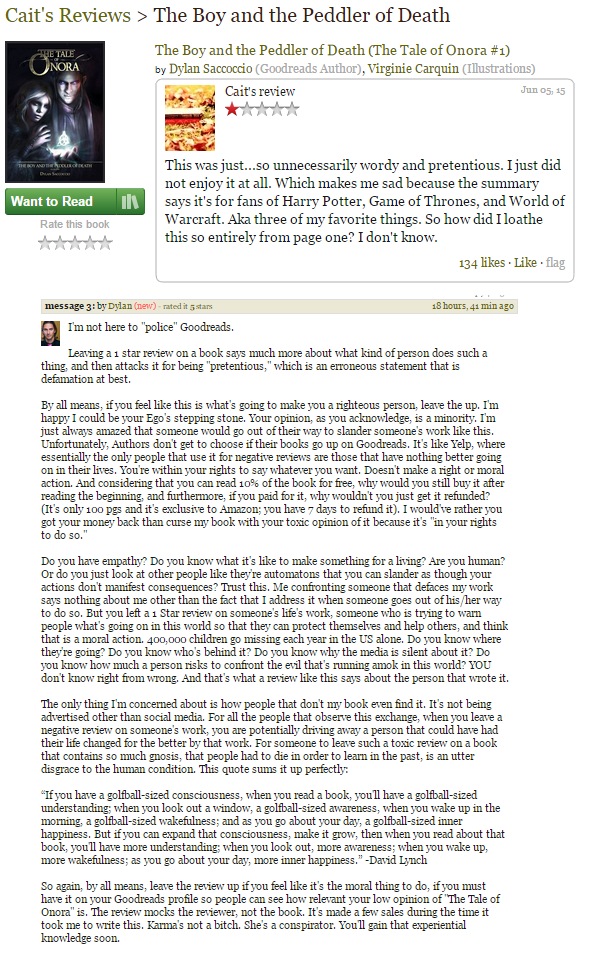
Bad Author

For context, this book had something like a 4.5 star average rating prior to this outburst. Look at the star rating now.

Despite the fact that flame-throwing is entertaining, funny, and something I can’t help but watch, it’s also cringe-worthy and unsavory for readers. Don’t make a bad name for yourself by responding to negative reviews (and I mean AT ALL). Do what other writers do: get a glass of wine, read a good book, and move on.

Self-Obsession

The number one mistake an author can make is acting like they are the only person on social media. These authors don’t interact, they don’t post anything but their own work, and they act like they’re a celebrity like Kim Kardashian who can get attention simply for existing.

The sad news is that you are not Kim Kardashian. At the end of the day, no one will care that you’ve written a book. You need to make people care. You need to engage with readers and prospective readers, you need to contribute positively to a community. And guess what? Doing so is easier than ever before thanks to social media.

What’s your biggest social media pet peeve?
How to Be a Successful Writer

So, you wanna be a writer, huh?

Well, it takes a lot more than just saying so. In fact, one of the most annoying things you can say to a writer is, “I wanna write a novel too, but I…”

And there you go. Insert some excuse as if us writers have somehow been able to get out of things that would keep regular people from attempting a novel or a collection of poetry or short stories. The excuses range from lack of time to lack of inspiration, from not having anything to say to having too much to say (see my post called “Why I’d Rather Pass a Kidney Stone than Talk about my Writing” where I delve into this phrase further).

But outside of the excuses, what does it take to be a successful writer? Check out these 7 basics you need to master to become a successful writer.

Is this you? Do you *want* it to be you?

Is this you? Do you *want* it to be you?

What *is* Success?

The word writer, at its simplest definition, means someone who writes. Full stop. But that’s not much to go on, is it?

Technically, anyone can be a writer, and the word is flexible enough to cover a whole range of possibilities: a writer is someone who writes a blog, a writer is someone who writes TV scripts or novels, a writer is someone who writes business reports or those fun little anecdotes at the back of cereal boxes. Lastly, a writer is someone who toils away in their spare time, crafting a collection of words to convey an overall meaning. In theory, unpublished amateurs are also writers.

So, now that we’ve determined that you’re probably a writer (or a potential writer), what does it mean to be a successful writer?

Well, like the definition of writer, the definition of success is equally as fluid. Does success mean simply seeing your work in print? Does success mean becoming a New York Times bestselling author? Does success mean making a livable income off of your work?

Only after deciding what success means to you can you start working toward your goal.

You Must Actually Write

So, you’re a writer now? You’ve decided how you will define success, and you’re ready to go all in. Bad news #1: deciding to write was the easy part.

To be a writer, you must actually write. To have a completed manuscript or poem or article, you need to write it first. And then you need to rewrite it. And then you need to edit it. Writing, like anything, takes work. A lot of work. And the process will be very thankless. I wrote for 8 years without anyone giving a damn, and the only reason I’m here today with my debut novel published is because I was persistent.

You must be persistent too, but that means putting in the time.

Which Witch is Which?

Congrats on *actually* starting to write, and welcome to the land of fruitless labor, blood, sweat, and… paper cuts?

You have now realized that you need to actually put words on the page (or your arm in a pinch), and that’s great, but that’s not enough. How are you at spelling and grammar? Good spelling and grammar is the cornerstone of good writing, and there’s nothing more embarrassing than finding typos in your published work (I may be speaking from personal experience).

Got grammar sorted out? Cool. On to the next thing: how about pacing? How about character development? How about writing a good plot? Writing is so much more than putting words together in a grammatical sense. It’s about creating an atmosphere.

Be Unique, but Be Involved

The hardest thing to do in any industry is to be innovative and unique. Everything has been done before to some extent. I repeat: everything. BUT! That doesn’t mean you can’t put a new spin on old ideas or concepts. That doesn’t mean you should write stereotypical drivel.

At the same time, however, don’t risk alienating yourself and your work to be unique. Don’t write according to trends, but know what trends are out there. Don’t copy the greats, but at least read them and understand *why* they are great. You need to be involved in the writing community in some way, and for the love of Reese’s Pieces, read a book every once in a while.

Understand that Writing is a Business

I hate to break it to you, but the writing industry involves money. Sure, you write for yourself. Sure, you do it because you love it. But guess what? If you want to be successful, you need to come to terms with the fact that you’re writing for an audience.

There is money involved with successful writing careers. It isn’t always a lot of money, but it’s there nonetheless. There are parts of the industry that exclude art completely, instead focusing on sell-ability and marketing and numbers. And if you choose writing as your day job (one where you write articles or other non-fiction content instead of fiction), understand that this involves writing things you might not always want to write. It involves adhering to style guides. It involves business.

That said, if you want writing to be your business, never write for free. Sure, gaining experience is great, but know what you can offer and refuse to have your work undervalued.

Use Your Voice

Developing voice is perhaps the hardest thing for a writer to do. Trust me, I know this from experience. Conquering grammar and spelling is relatively simple, albeit annoying (Further? Farther? I’m over it), but voice is not something you can read up on and then regurgitate the next time you sit down to work on your latest piece.

Unfortunately, developing your voice simply comes with time. After plugging away at almost 220,000 words across three different manuscripts, I finally reached a point about two years ago where I said, “aha! I’ve found my voice”. But I’m not lying. It took six years and 220,000 words.

To Be an Artist is to Fail…

I’ve saved this point for last for one simple reason: the decision to write should be inspiring. You should be inspired to commit to daily or weekly word counts. You should be inspired to learn the ins and outs of grammar. You should be inspired to develop your own unique voice.

However, like all other professions within the arts industry, being a writer is an acceptance of failure. You will fail at some point. You will have your work rejected. You will have it chewed up and spit back in your face. You will face the fact that, at the beginning (inherently), no one cares. Seriously, I see many an amateur writer crumble and spiral into depression because they’ve come to the realization that no one cares about their work.

But embrace it. Work hard so that eventually (and I mean far-away eventually) someone will care. Sure, failure is guaranteed, but in order to be a successful writer, you need to be persistent. The only way to be persistent is to write because you love it.

Do you have any tips on being a successful writer?

Wednesday Writerly Update #5

Well, hello!

It’s that day of the week again, the day where I fill you in on my minimal writing progress so that you can feel better about your own word count. And spoiler alert: I didn’t do much writing, but that’s okay because I *thought* about doing some writing, and intention is the first step to progress, right?

Right.

Anyways, I did a free write last week (Thursday? Friday? I don’t know). It was a 500 word scene, presumably some sort of speculative fiction. It has a distinct Middle Eastern edge that I like because I have a fascination with Middle Eastern culture at the moment, and it involves the desert and traveling gypsys. I kind of like it, but I don’t know what to make of it, and I don’t know if I like it because it’s incorporating Middle Eastern culture or if I *actually* think there may be a story there.

In any case, now that my NA Inception-meets-The-City-Trilogy WIP is in that weird limbo between completed self-edits and pre-publication shenanigans, I want to start focusing on other projects. I have the first draft of a YA  Horror novel I wrote over the winter, and the next step is going to be editing that one. I feel like it’s going to take a good bit of rewriting though. My intention was to write a classic horror novel with seances and Ouija boards and the like, but now I need to make sure I don’t fall into the trap of writing stereotypical horror.

Also, I have that YA contemporary WIP that sits at 15,000 words and has been since autumn. It’s completely different from anything I’ve ever done (it’s not spec. fiction at all; rather, a drama). I did a chapter-by-chapter outline the other day (which I rarely do) to see if direction would motivate me continue writing, but to be honest, I don’t feel all that motivated.

And lastly, for news pertaining to The Black Oracle:

  • The review tour is winding down, but there are still two stops on June 14th, so if you want to review The Black Oracle, now is the time! You can still review after the tour, of course.
  • The Black Oracle will now be sold at Forster’s Book Garden in Bolton, Ontario (an independent bookstore). Copies should be available shortly. Are you a bookstore owner? Contact me, and we’ll arrange some copies for your store!
  • Some cool promotions are headed your way soon! I have a few ideas in the works for promos over the summer months, so stay tuned.

I hope everyone had a good (and successful) writing week. Until next time!

The 7 WORST Cliches in Young Adult Fiction

Also check out the 8 WORST Cliches in Fiction. Because cliches are everywhere, and acknowledging that we have a problem is the first step to recovery.

I’m going to start off by saying I love Young Adult fiction. I grew up on Young Adult fiction, and I still read Young Adult Fiction (yes, I know I am a grown man, but I make my own money now, so I do what I want).

However, there are certain things about Young Adult fiction I just can’t stand. Yes, I understand there is an unofficial formula. Yes, I know there are things every Young Adult novel MUST do. And yes, I know *not* adhering to certain expectations will cast your novel into the world of unsold oblivion.

But, seriously. There are some things that just. gotta. GO!

“I Love Him. I Hate Him.”

Okay, listen, this isn’t high school. Except… yes, it is.

The point is, we get it. Being a teenager is tough. Your hormones are out of control, you’re feeling things you’ve never felt before, you probably smell, but you won’t realize you smelled until you reach twenty and get a whiff of teenagers.

I digress.

Relationship drama was and is the most annoying part of high school, was it not? Two people who love each other but don’t love each other and then decide they can’t be together for whatever reason but then get back together anyway because they can’t stand being apart.

crying-screaming-sobbing-guy-gif-first-world-problems

Just stop. It’s done. We all lived high school. We don’t need any more YA lit to recount those experiences. Write about something else.

Related: The Love Triangle

Team Edward or Team Jacob? Team Gale or Team Peeta?

How about Team Stop-It-Already! I understand love triangles make things interesting. I understand from a marketing perspective it’s a good way to polarize readers, fuel passionate discussion, and ultimately get hype about a book. But it’s old now. It’s overused and boring.

anigif_enhanced-buzz-10113-1382948371-0

In fact, trash stereotypical love altogether. I want to read a YA novel that *doesn’t* focus on it for once.

It’s the End of the World!

This one is ironic for me, isn’t it? Yes, my novel “The Black Oracle” takes place *after* the end of the world, but no: it is not *about* the end of the world.

In any case, dystopias are getting a little out of hand. And I love dystopian literature which is why I’m particularly against this cliche. It’s like they’ve taken the same story over and over again and recycled it for more $$, and that’s a terrible reason to write a dystopian novel (or three. See below).

angry-dwight

So, I revise: dystopias aren’t the worst. They’re actually pretty awesome. We just need something new every once in a while. Or for at least the next ten years.

Related: REBELLION!

The worst cliche within the cliche of YA dystopia (cliche-ception?) is the fact that main characters have to rebel against the dystopian society they’re living in. When it was done in the Hunger Games, it was pretty cool. And then it kept happening, again and again like a bad cold that keeps returning.

tumblr_inline_nnbzvfUOQX1rsoel3_500

And the whole “reluctant hero” thing? Ugh. I’m sick of main characters who are tossed into a rebellion and the whole time they’re like “but what if I can’t be a good rebel? Waahh”. Well, move over then. Let a passionate character who actually wants to overhaul society be there.

First Person, Present Tense

I walk into the room and pick up the book on my nightstand. The cover is glossy, the words protruding from the page like uneven pavement. I open the book and glance at the first page. I release the breath I didn’t know I was holding. Oh no, I think, not another one.

The novel is in first person, present tense.

screaming

You wanna know what my biggest qualm with first person, present tense is? Besides the fact that it is terribly limiting, and it generally makes me detest main characters, it is also horribly contrived. Who *actually* speaks or thinks in the way main characters in first person, present tense main characters do? Do teenagers really think in metaphor? Do they play around with sentence structure and randomly use enormous words to demonstrate their authoritative command of English prose?

No. No, they don’t. Write in third person already, and I won’t spend the entire novel thinking about how unrealistic a character is.

The Trilogy of Three Books that Could Have Been Better as One

The title says it all. If I find out a YA novel is part of a trilogy, I’m turned off. I see the appeal (mainly because it drives people to buy more than one novel), but good things don’t always come in threes. Why stretch out the plot over three novels and fill space with drivel when a writer can compose one single awesome novel?

68ea9a69dba3765d4caf78d371babf51

In fact, I wrote about this at a length in another blog post. I feel like there’s a pressure in the industry for authors and prospective authors to write three novels, and I don’t think it’s right. I believe in writing a trilogy because an idea is too long or too all-encompassing to cram into one novel. Don’t stretch it out for the sake of making more money. While we’re at it, stop dividing final movie adaptations into this part one, part two bullcrap!

The Hunky Male is Hunky… and Also Magical

Maybe it’s because I’m a guy, but I just don’t get it. Sure, hunky men are fine, and they get readers all hot and bothered, but why do they need to have magical powers or be super sexy aliens from the planet Frion sent here to make human girls squeal?

It’s just annoying. And a little condescending. Is a man not attractive unless he’s got magic powers? Isn’t that an odd commentary about the state of male-female relationships?

You know what? It doesn’t matter. Just make the love interest normal or write him out completely.

Jack-Nicholson

What are your least favorite cliches in YA books?

The Black Oracle OUT NOW!

Hey everyone!

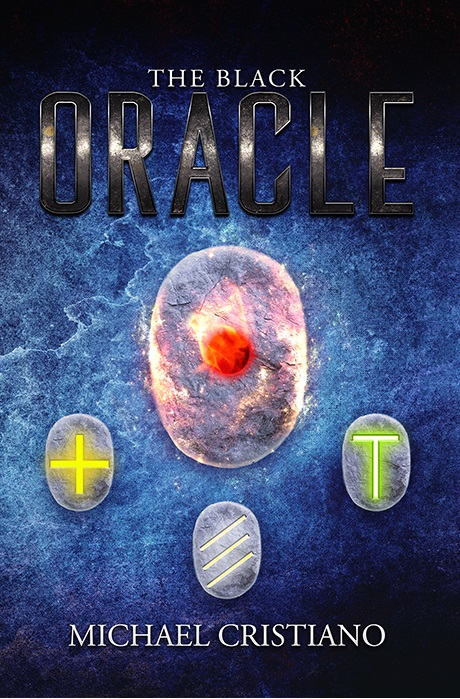
I am happy to announce that today is the day that “The Black Oracle” is available worldwide! You can pick up an eBook copy here or a paperback copy here. If you do get a copy, please be sure to leave a review on Amazon or on Goodreads, good or not-so-good. Check out the description:

The_Black_Oracle_Cover“On a post-apocalyptic Earth, humans are not alone.

Joachim is a hunter. Though generations have passed since the Great Death, something has evolved in the trees beyond the giant glowing mushrooms, mutants that want to see human entrails spread along the jungle floor.

And now they’ve taken Joachim’s wife.

To get her back, Joachim will have to give the leader of these demons something in return: immortality. A creature knows when he is going to die, after all. Plunged into a world of magic and darkness, Joachim must find the only woman who knows where the ingredients are. She is a prophetess known as the Black Oracle living in the realm of Zalm, but she’s a little preoccupied at the moment. She leads a rebellion against the ruthless High Council, and when Joachim seeks her out, he too finds himself consumed by her struggle.

In a story of betrayal, prophecy, and bloodshed, Joachim has ten days to retrieve the ingredients and return to Earth all while evading the High Council’s army, one that wants the Black Oracle and her associates killed — Joachim included.”

So without further ado, I thought I’d post an excerpt to celebrate.

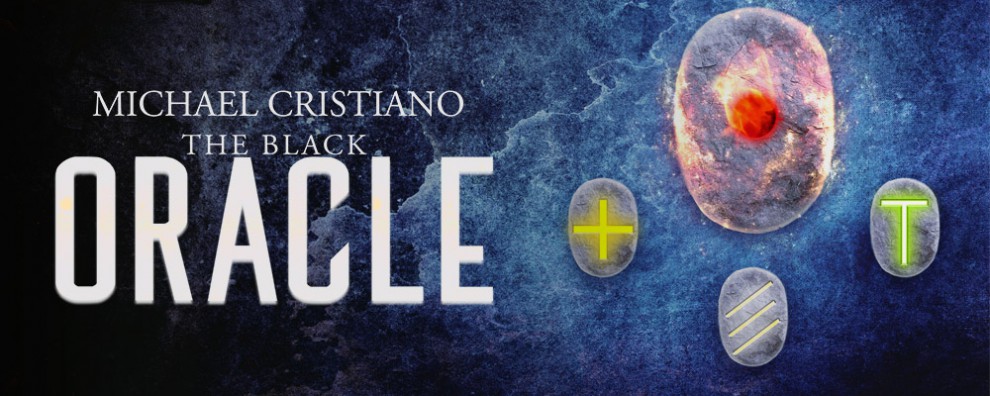
banner

“Darcie had been sitting in the doorway when he returned to the village not yet two evenings ago. The day had been hot, and Joachim was sweaty and dirty and tired. He lowered his rucksack, and she closed the book she had been reading, one from Baruch’s Old Earth library, like all the others.

“Welcome home.”

He’d spent the last six weeks in the arms of the jungle, the cold, dark, unforgiving wilderness that never truly felt right even on the most beautiful of days. Joachim had hunted in those trees all his life, but nothing compared to Darcie. In her eyes, he was home.

“How did the great hunters fare?” she teased. “Did you take down three alligators this time? How about an elephant? Will we have enough elephant meat to last us until next summer?”

“Not quite,” Joachim replied.

She stood with her hands on her waist. From the back, someone would think that she was upset if not for the expression on her face. She watched him from under her brow, her chin turned slightly downward. She smiled.

“I missed you,” he whispered as he snuck his hands onto her hips.

“No, you didn’t.” She smirked. “You and Ben and Trent are like children out there—like young boys. And the jungle is your little paradise.”

“What if I told you that you are my paradise?” He kissed her neck.

She snorted. “Oh, please. Think you can just walk in here and woo me with some flattery?”

“I know I can.”

Darcie’s arms snaked around him. Her lips were as intoxicating as barley sweetened in the sun, and soon, he lifted her off of her feet and pressed her against the wall.

“Joachim!” she exclaimed. “The neighbors.”

“There’s no one watching.”

She laughed and hit him lightly on the chest.

“How was everything while I was gone?” Joachim asked.

“Fine,” Darcie said. “Boring.”

They went inside the dwelling. There was simmering jackalope stew on the stove.

“Ophelia’s ceiling had a leak last week,” Darcie continued. “A big rainstorm pushed through here, and it ripped some of the roof off. Did you get a storm out there in the jungle too?”

“Yes,” Joachim said. “I’m not even sure my rucksack is dried all the way through yet.”

He dipped his finger into the stew. It tasted salty.

“And how are you?” he asked.

Darcie played with a lock of her dark hair and bit her bottom lip. She reminded him of the day they married. There had been no parent left to walk Darcie down the aisle, so she walked herself. The whole time she eyed him: shy yet eager. Almost childlike.

“I’m pregnant,” she said.

He almost dropped his hand back into the stew. A little boy, she had just called him, alluding to his exhilaration whenever he entered the jungle. And Darcie was right: he often became so energized that he did feel like a little boy—and he felt like one again now. He felt like laughing, like scooping Darcie up and twirling her around. He could feel life bursting through his chest: ravenous innocence and maddening excitement. They’d been yearning for a child for so long.

“You are?”

“I found out into the second week of the hunt.” She touched his face. “I skipped my cycle, and I told Jolyne. She ran a test and told me I was expecting.”

Joachim cried. The hunter was supposed to be brave, but being brave sometimes meant having courage to show his emotions. He wept for her, smiling and laughing through the tears, and she cried too.

She spent the night tight to his chest and coiled in his arms like a huntress in camouflaging paints, like a butterfly in a cocoon.

Like she was protected by a shield.

Joachim wished she were there for him to protect now. She hadn’t mentioned the creatures that evening, and he doubted she even knew that they had come while he was away. But now she was gone, and so he had to be too. If he waited too long, the creatures would keep her away from him forever.

If she wasn’t already.”

ender

Headshot.The.Black.Oracle

Michael Cristiano is a Canadian writer. His relentless obsession with writing began long before he could spell the words ‘relentless obsession’. Growing up in endless suburban sprawl, he spent most of his childhood pretending to be Harry Potter and attempting to get published by the age of thirteen.

When he isn’t writing or reading, he can be found planning his next backpacking trip around the world. He is a recent graduate from the University of Toronto with studies in Foreign Language and Linguistics. Previously, he attended a Regional Arts high school where he majored in drama. He is fond of all things dramatic.

Michael currently resides in the Greater Toronto Area, and he is using his years as a twenty-something to establish what he hopes will be a long career in writing. He works in editing and acquisitions for Curiosity Quills Press, and his freelance work has appeared on websites such as Nexopia, FluentU, and BlushPost. The Black Oracle, his debut novel, is out now.

Like him on Facebook. Follow him on Twitter.

How to Write a Novel that Will ACTUALLY Be Worthy of Publishing

Ron-Swanson-Every-Word-I-Know

So, you say you have a dream, Mr. Martin Luther King Jr. of prospective fiction (or nonfiction) writer. Well, so do I, and so do millions of others around the world. That is to write a book, but not just any damn book: a book that will be good enough to publish.

Seems like a pretty simple goal, right? In today’s day and age, there are a billion ways to see your work published: paperback, hardcover, ebook, literary magazine, traditional publishing, self-publishing, hybrid publishing, serialization, writing your novel on your arm and reciting it in the subway (okay, maybe not that one…)

Since publishing a book is easier and more accessible than ever before, it’s important to know how to write a novel that’s worthy of being published.

Read Widely

“This is a given,” you say. This is what got you into wanting to write the most epic, mind-shattering, life-changing fiction in the world in the first place. It’s amazing though how quickly reading gets shut out of life after a 9-to-5 job, commuting, cooking, cleaning, sleeping, and meeting word counts consumes all your time.

Trust me, I’m guilty of putting reading at the bottom of my priority list. I find it hard to find time to read, but it really is necessary for a successful writing career. Reading allows writers to become fluent in their craft. It allows us to see what works for other authors, and what could work for us. It allows us to stay on top of what’s happening in the publishing industry and to analyze those happenings and apply them to our own career.

And you MUST read widely. Don’t only read the genre you write. It’s tempting to say, “Oh, well, I only write fantasy, so I’ll read myself silly with George R. R. Martin and J. R. R. Tolkien and Terry Pratchett”. Read everything. Read contemporary and young adult and romance and how-to manuals about square dancing and cat-sitting.

The classics are also a must — and believe me when I say that you won’t detest them as much as you did when you were forced to enjoy them in high school.

Learn How to Write & Edit Like Mad

Writing without knowing anything about the craft is like scuba diving without an air tank. It’s like running a marathon without proper shoes. It’s like driving a car with your eyes closed (which I do not recommend, to be clear).

You need to invest something into your writing, and I don’t mean that you have to toil and toil over plot points and character development and 100,000 cat videos on YouTube (though, that’s all included). You’re going to need to get control of your grammar and the conventions of your genre. You should invest in a style guide and maybe even read a few how-to‘s and don’t-do‘s. There are millions of resources online and at your local bookstore, and if your interested in improving your craft, I’ve already written a post with tips.

Even when you’ve mastered all those semi-colons and romance novel tropes and Oxford commas, you must still edit. All manuscripts go through a revision process, sometimes upwards of ten times, and if self-publishing is the right route for you, it is ESSENTIAL that you hire a professional editor to prepare your work for publication. There’s nothing more terrible than a novel that has grammar, spelling, and plotting issues (except maybe driving with your eyes closed).

Don’t Follow Trends

Are vampires and zombies cool anymore? No, it’s dystopian fiction and Fifty Shades of Too-Embarrassed-to-Be-Caught-Reading? Well, then.

Following trends doesn’t work. By the time you write something that follows a trend, polish it, and publish it, chances are that trend will be on the way out or already gone. Besides, it’s even worse when a writer writes something in order to try to capitalize on the bee’s-knees-du-jour, and it’s so blatantly obvious that they did that they write garbage. These novels lack originality and personality.

So, screw the trends. Write something that feels right for you, and maybe you’ll grandfather (or grandmother) your own trend. Talk about mind-shattering!

Know When It’s Crap

Ah, my USB. It’s a place where all the magic happens — and also the place where manuscripts go to DIE! Truth be told, not all of you work is meant to be published. Sometimes we write something full of cliches and plot holes and enough literary conventions to make Shakespeare hiss in territorial protection.

And that’s okay! You’re allowed to write crappy every once in a while. I did it. I have a manuscript that’s been edited multiple times but is now enjoying retirement in my “Nice Try” folder. I even have a nice disclaimer on the front page that says “In the event of my death, DO NOT publish posthumously”. It’s that crappy.

How do you know when it’s time to let go?

  • You’ve Lost Interest. That initial spark is gone, and writing the piece feels like drinking three-week-old urine with ground up ceramic. Yeah, that feeling.
  • You’ve Written Yourself into a Hole. This is the hardest time to let go. This happens when your plot is so mangled that it’s unrecognizable. It’s unfocused and messy, inconsistent and terrible. Sure, you could edit, but is it worth it? Maybe let it be for a while and come back later.
  • You’re Not Ready. We all need the opportunity to fail. Sometimes what you write is just the trial edition. You can’t run a marathon without training. You need some practice runs, so to speak. It’s important to know when you’re writing a practice run, especially if you’re just starting out and writing your first novel.

How do you know when something you’ve written is worthy of publication? Do we ever really know?

Wednesday Writerly Update #1 (THE BLACK ORACLE Available for Pre-order!)

Happy Wednesday everyone!

Before we begin, I am crazy excited to announce that “The Black Oracle”, my debut post-apocalyptic New Adult novel, is available for pre-order on Amazon! One click gets it auto-delivered to your Kindle on May 25th, and if you haven’t added it to your Goodreads list, do so here.

excited-baby

Whew! Sorry, I’m a little overwhelmed. I may need a little time-out.

Okay, the excitement has passed. Moving on.

So, I’m part of a group of New Adult Speculative Fiction writers on Facebook (yes, the genre exists, and you should join us), and a bunch of us are taking part in a weekly blog hop about our writing progress (or in my case, lack thereof). I’ve decided to call mine Wednesday Writerly Update, and each week I’ll give you all the low down on how much or little fiction writing I’ve gotten done. I’m not sure if anyone will care, but it’ll be a nice way to hold myself accountable to my word counts (and maybe even see what headway I’ve made on my 2015 writing goals).

Without further ado, here we go!

I am happy to announce (mostly to myself) that I have finished a short story and submitted it for consideration into an anthology! It’s a dark fantasy piece with horror elements, and I’ve had the draft sitting on my computer for years (almost 5, I might guess), so it’s nice to see it polished and sent off.

As for any potential WIPs, I am currently trying to add 15,000 words to my newest NA Speculative Fiction (I like to think it’s Inception meets Darren Shan’s The City Trilogy). Long story short, I thought it was finished at 50,000 words, but then it wasn’t so I wanna pump it with more words and then edit and submit and *hopefully* see it in print in 2016. There! I said it: my first 2016 goal.

In any case, I’ve written 3500 words in the past three weeks (I’m slow, okay?!), but I would like to see me writing 2500 words a week so that I can start editing by July.

So new goal: write 2500 words by next Wednesday. Wish me luck!

Got any goals? How do you hold yourself accountable to them?

Authors for Indies Day Recap

Hey everyone,

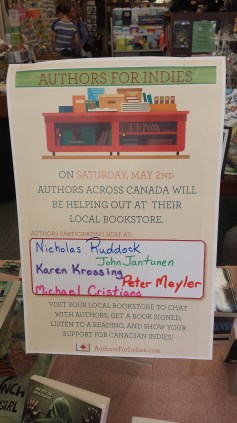
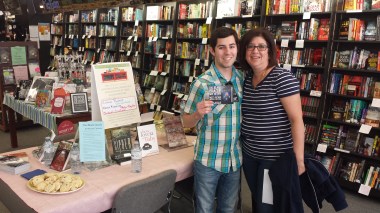
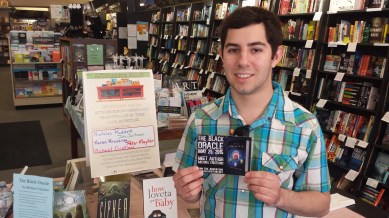
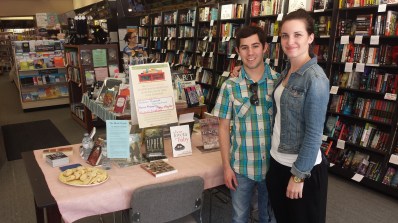
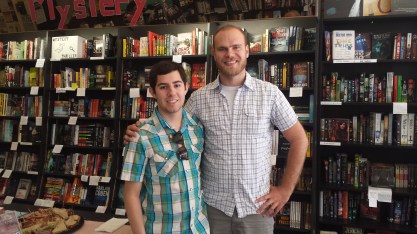
Just a short post with some photos from this past Saturday’s Authors for Indies Day. If you have no idea what I’m talking about, check out this post about the Canada-wide, annual event.

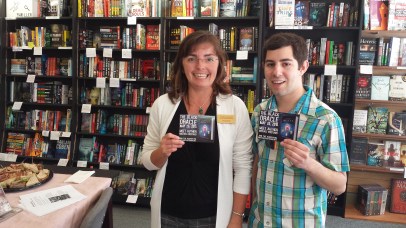
All in all, it was a great day! The bookstore was pretty quiet, but in a way, I’m glad. For my first event, I didn’t want hundreds of people to swarm and ask my-awkward-self a billion questions. Instead, I got to hang out with some other awesome writers and meet *hopefully* a few readers for when The Black Oracle comes out.

Check out these photos!

20150502_144811

Look! My name!

20150502_141210

My Mamma and I.

20150502_141220

Derp.

20150502_145436

20150502_145407

20150502_145616

Me and Roxanne from Roxanne’s Reflections in Fergus.

By the way, the Black Oracle is being released in 21 days!

If you haven’t yet added on Goodreads, check it out now! Do it!

5 Ways to Stretch Your Word Count

writing

This time last year, I thought my newest New Adult speculative fiction work-in-progress about the collective subconscious and evil corporations was finished and ready for the world. Since then, I have gotten sidetracked by the release of my first novel entitled The Black Oracle and by the launching of my full-time writing career. During all this time, I have been on a steep learning curve, growing exponentially in the world of writing, publishing, and editing. It wasn’t until I *actually* went to prepare my New Adult speculative fiction novel for publication that I realized I had a problem: the word count of 50,000 words was too short.

Now, I know what you’re thinking. In fact, I’ve already heard it from my critique partner. “When your novel is done, it’s done“. That is to say that once a piece is finished from beginning to end, and it has been edited to the point of being ready for publication, it’s silly to go back. It is what it is, so to speak, even if it is a little short.

But that didn’t stop me from doing research. In fact, Literary Rejections has a fantastic post about standard word counts for all genres, and they peg the average for New Adult at between 60,000 and 80,000 words. “Be the rule, not the exception,” they advise.

And whether or not writers want to admit it, word counts count, and editors and agents judge you on them every. single. day.

So that’s when I decided to pump 10,000 to 15,000 new words into my New Adult speculative fiction novel. Currently, I’m trudging through it, daily word count goals slowly driving me insane. It isn’t easy to add more words to a novel that I thought was finished. I needed a plan. Luckily, I was able to find 5 tricks that help to stretch word counts without adding mindless filler and unproductive storytelling.

Explore Backstory

For me, this is going to be one of the best ways to gain a few thousand words. Writers spend a lot of time fleshing out a character’s past experiences and thinking about how those experiences lead them to their actions within the story. The problem: much of this backstory stays with the author. These character sketches don’t always make it to the finished product.

But why not? Why not make those experiences available to the reader?

Write a good flashback. Have a character tell a story about a past event. Have your main character reflect back on a past event. There are many ways to weave backstory into your plot without writing entirely new scenes and without info-dumping, and doing so is a great way to increase your word count.

Slow Down the Pacing

I must admit, I am a fast-paced sort of writer. I don’t like writing filler scenes, and I don’t like taking my time. I want the action to happen, and I want all my storytelling to be as productive as it can possibly be.

Downside: I write shorter manuscripts. It’s not a crime since some of the bestselling books of all time have been short, but it definitely makes me a touch insecure when I read about word count expectations. So when writing, I try to keep mind to slow my pacing. One of the techniques I use is to plan out my scenes before I write them. Without a plan, I could probably write an entire novel in ten pages (a crappy novel, no doubt).

Secondly, I aim to slow my pacing through my word choices and sentence structures. We live in a society where a lot of description in prose is frowned upon, and though I don’t go all Tolkein-esque and spend pages upon pages detailing trees and rocks, I use my sentences to better flesh out ideas and settings. A longer word count is just a happy by-product of that process.

Develop Your Characters

One-dimensional characters are often the death of a potentially great novel. No one likes to read a character that has no goals, no genuine emotion, no life. The best ways to develop your characters are to give us access to their thoughts and dreams, give them a backstory (see above), and give them reasons for being in your story.

Again, by-product: all of this character development takes a time, thus stretching your word count.

Write a Subplot

This is my favorite word count stretching technique. I love subplots. LOVE. I would write an entire novel of subplots if I could. There’s so much freedom in taking a character and developing their actions into a quasi-separate story. And then when the subplot mixes and mingles with the main plot? Gold. GOLD, I TELL YOU.

Check out this cool post on the different types of subplot and how they can seriously enrich and advance your story.

Make Things Complicated

Last but not least, stay away from easy. This technique sounds like a given, but believe it or not, a lot of authors fail to make their stories complicated and thus interesting. Some stick to the A-event + B-event = Conclusion model, and this is terribly boring.

Give your reader something more. Add additional events to your plot-development equation, ones that make the main character work for their reward. If the story is straightforward and predictable, the reader will also find it straightforward and predictable. Add some uncertainty. Add some misunderstanding. Add some betrayal.

All of this will help to enrich your story and yes, stretch your word count.

Got any techniques for increasing your word count? Do you even bother to try to meet industry or self-imposed word count standards?

Authors for Indies Day!

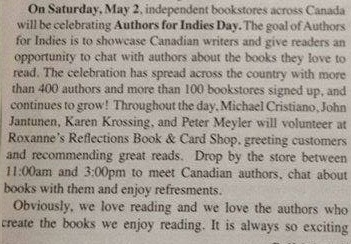
As some of you may or may not know, I am doing my very first promotional event for The Black Oracle two weeks from now. I am going to be at Roxanne’s Reflections Book and Card Shop in Fergus, Ontario on Saturday, May 2, 2015. The occasion? It’s Canadian Authors for Indies Day!

Look, Ma, I'm in the newspaper. #basicallyfamous

Look, Ma, I’m in the newspaper. #basicallyfamous

Authors all across Canada will be in independent bookstores on this day to volunteer and promote indie publishing and book selling. Why not volunteer at a chain bookstore? Independent bookstores offer a great alternative to mainstream, multi-location stores. They provide welcoming atmospheres, caring employees and owners, and best of all, they allow for a wider selection of books than other corporate giants. Independent bookstores are often the first to open their doors to independent authors — something that big chain booksellers make it hard to do unless you have a major publisher and distributor.

So, naturally, when my publisher Curiosity Quills Press suggested I team up with a bookstore for this awesome day, I jumped at the opportunity. Independent bookstores have been a huge part of my book-loving and writerly life. Since I was young, my parents have taken me to cottages every summer. We cottaged along the Trent River, on Lake Eugenia, and about five years ago, my parents fulfilled their dream of buying a cottage near Belwood Lake.

My favourite thing about cottaging is the lack of distractions. I could hang out on the patio for hours on end with very limited cellphone service, absolutely no internet, and a book in hand. The best part: I got to explore the towns nearby, ones with a good independent bookstore or two. When my parents settled near Belwood Lake, some of my favourite days were spent exploring Fergus. That’s when I discovered Roxanne’s.

Little did I know at the time, Roxanne’s Reflections is a community favourite. Roxanne and her staff are friendly and helpful, and always striving to find readers the perfect book. I’ll never forget when the film adaptation of The Great Gatsby came out a couple summers ago, I wandered into Roxanne’s looking for a copy. I’d read in in high school and hated it (I know: how silly of me!), but Roxanne had a huge selection of special edition copies, and I bought one and consumed its contents all in one day.

I guess what I’m trying to say is that independent bookstores like Roxanne’s Reflections really care. It’s easy to walk into a chain bookstore, get overwhelmed by the endless tables of supposed hot fiction, and then encounter a staff member who may not know Aldous Huxley if he walked in and smacked said employee in the face.

So, this May 2, head out to an independent bookstore and show your love even if you do not reside in Canada. If you’re in the Fergus area, drop by Roxanne’s between 1 pm and 3 pm. I’ll be there then, but it is an all day event. Otherwise, check out Authors for Indies website for a location near you. Who knows, you may just encounter Guy Gavriel Kay!