Hey everyone,
Long time, no see. I know, I know. It’s been a while since I’ve been around these parts. It’s been quite a crazy past few months, you see. Between secret projects and new manuscripts and a new business I launched in October, I’ve been a little out of sorts and definitely slacking on blog posts.
So, I’m back! And to kick off my return, I have an interview with an amazing New Adult Speculative Fiction author (and good friend of mine) named Jessica Gunn whose first novel Gyre has been published TODAY (AHHH!!!). Check it out:
- Hey Jessica! Congrats on your first novel being published! Having had my first one published last year, I know it is an awesome yet terrifying experience. How are you holding up? Any plans for release day?
Hah! I was doing okay until the book went up on Netgalley. But really, I’m excited. This is my dream! Regardless of what happens next—though I do hope readers enjoy the book—there’s self-satisfaction in this and I’m going to enjoy every bit of it. Especially because this is Gyre that’s being released into the world. Gyre and I have been through a lot!
- What was your journey to publication like?
Long and filled with many revisions! I started Gyre in November 2012 for NaNoWriMo, then spent many, many months revising the book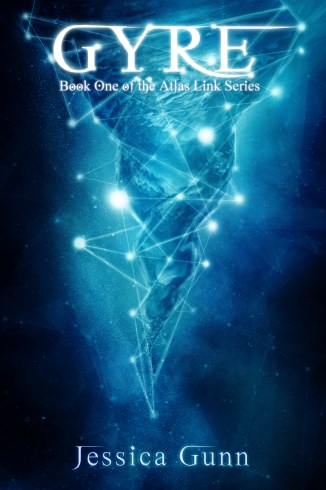 . It was the first novel I really took seriously as far as publication went, so it was also the first manuscript that’s had critique partners look at it. Since 2012, I think Gyre went through 4 major overhauls and 2 querying rounds, including a Pitch Wars run, before it finally found a home at Curiosity Quills who, actually, was the first press I looked at in 2013 that I wanted to send it to if I went the small-press route.
- So, let’s be clear, Gyre is awesome (check out my review)! Where did you get the idea? What are the major inspirations for this novel?
I’ve always been in love with the idea of Atlantis and other ancient mysteries. I find the idea of Atlantis almost romantic and I really just wanted to explore it in a new way and without the various sea creatures usually attributed to it. The rest of it sort of just fit together.
- Without giving too much, Gyre focuses on the lost world of Atlantis. Have you always been interested in lost worlds? Why did you choose to write about Atlantis?
Yeah, pretty much. I’m not sure exactly when or how the fascination with lost worlds started but I’ve always been into ancient history and dinosaurs and fantasy, especially Atlantis. I’ve always wanted to use Atlantis in a story, so for Gyre it was an instant choice, but it also worked because I wanted to use a more atypical setting for new adult fantasy/sci-fi, and “underwater” fit. Besides, the story of Atlantis is so timeless! I don’t think I’ll ever get enough of Atlantis stories 🙂
- On your website, I saw that you have a degree in Anthropology. That’s so cool! How do you think that influences your writing and Gyre?
I think I approached the mythology and historical aspects a bit differently, in that my characters tend to try debunking things instead of just going with it. For instance, Chelsea doesn’t want to believe they’ve found evidence of Atlantis. In fact, she might be the last person on the whole station that accepted what they found. I’ve found anthropology, specifically the archaeology field, is as much about studying humans as it is debunking crazy claims until there’s nothing left but the truth.
- I was excited to find out the Gyre is the first book of a larger series called The Atlas Link Series. How many books will there be? What can readers expect from the rest of the series? Can you give us any tidbits to tide us over until book two?
Yay! I’m glad you enjoyed Gyre enough to want to read more 😉 There are five planned books! I so really shouldn’t give tidbits for risk of spoiling Gyre but I can say that as far as the time traveling and ancient history aspects go, what the characters discover in Gyre barely scratches the surface.
- Now that your first novel has been unleashed on the world, what advice do you have for prospective published authors? Is there anything you would have done differently?
There’s a fine line between writing for yourself and writing what the market wants. Sometimes it’s good to steer way away from that line and do what you love, and sometimes there’s a good reason to tread carefully. I wish I’d have known that, as well as knowing that everyone’s on this journey at a different pace. Your publication journey will never be identical to someone else’s, so there’s absolutely no use in comparing. Easier said than done, I know.
- Last question: in a sense, Gyre focuses on travel and uncovering the unknown. I myself am a huge travel nut. If you could travel anywhere, whether the place is in the real world or completely fantastical, where would you go? What would you bring with you?
I’m not sure if this is cheating, but I would 100% go to the Tardis and I would bring the Doctor. Then I could go anywhere, in any time. Even if the Tardis decided to be snarky like she sometimes is and drop us off wherever she wanted, at least I’d have gotten to the Tardis!
Not cheating answer: Stonehenge, right after it was built. That’s one mystery I want to see absolutely solved!
And Now… More About Gyre:
Chelsea didn’t try to teleport. All she wanted was to play the Battle of the Bands show. But after accidentally teleporting onto classified Navy vessel SeaSatellite5, all she’s rocking is the boat. Once it’s sorted out that Chelsea’s not a threat, SeaSat5’s top scientist offers Chelsea a position on the crew as an archaeology intern. Dr. Saint studies people with powers, believing them to be descendants of Atlantean refugees, except Chelsea’s powers are beyond anything on previous record.
While great for everyone else onboard, the miracle of Chelsea is Trevor’s worst nightmare. The same girl who’d given him a brief lifeline to sanity three months ago literally fell from the sky, under a mile of ocean, and onto the very station where he’s employed. Making matters worse, Trevor’s family are Lemurians, Atlantis’s enemy, and Chelsea’s presence is unpredicted—a wrench in an already unstable situation. But Trevor wants no part of his family’s war. The only thing he wants is Chelsea, Atlantean or not.
Days into Chelsea’s sudden appearance, SeaSatellite5 uncovers Atlantean ruins and a massive artifact cache, placing its entire, hundred-man crew in the crosshairs of an ancient war. There are those who want the Atlantean relics inside the ruins destroyed, and only Trevor knows the treasures for what they really are: Link Pieces, tools used by the ancient civilizations for their time-travel war.
With lies and shifting alliances abound, Chelsea and Trevor will have to think fast in order to save the station. If they don’t, the Lemurians will seize the artifacts and Atlantis will be destroyed forever.
More About Jessica Gunn:
 Jessica Gunn is a New Adult author and avid science fiction and fantasy fan. Her favorite stories are those that transport the reader to other, more exciting worlds. When not working or writing, she can be found binge-watching Firefly and Stargate, or feeding her fascination of the ancient world’s many mysteries. Jessica also holds a degree in Anthropology.
To catch up with Jessica, follow her on Twitter (@JessGunnAuthor) or on her website, www.jessicagunn.com.
Twitter | Facebook | Instagram | Goodreads |Website | Blog | Pinterest

 Michael Cristiano