Tag Archives: writing a novel

Writing Book #2

An odd atmosphere has enveloped my writing life recently. Aside from the fact that I found myself practically unable to write after the release of “The Black Oracle” and I took a nearly two-month break from productivity wherein I dabbled in random short story endeavors that resulted in no finished products, I am now in a new writing phase.

I’m attempting to write a book #2.

No, it’s not a sequel to “The Black Oracle” (cuz seriously, I’ve been asked that a lot recently). I have played with the idea of writing a sequel or a prequel or both to “The Black Oracle”, but right now, it feels best as a stand-alone, and though I won’t say never, I will say not now.

In fact, my book #2 is for that Inception-meets-The-City-Trilogy new adult speculative fiction I completed back in May. Further, I have a second book #2 for my middle grade paranormal/horror novel that I wrote over this past winter (even though the first book is trapped in editing hell where I toil fruitlessly to get the tone right).

So, I’m in a weird place. After writing stand-alone novels for almost all of my writing life (the better part of eight years), I am facing the fact that I am writing not one but TWO sequels. It’s odd. I feel like it’s akin to raising the dead. In terms of the Inception-meets-The-City-Trilogy story, I knew very early on it would be a series, and I currently have four books planned. But after reaching a point of finality on the first one this past May, resurrecting the tone and the characters and the plot feels kind of foreign — almost unnatural to me.

It’s not that I feel directionless, I just worry I might ruin the stories by adding more to them. I mean, what if subsequent novels don’t live up to the first one? What if there is no more story to tell, and I’m just stretching it out for who knows what reason?

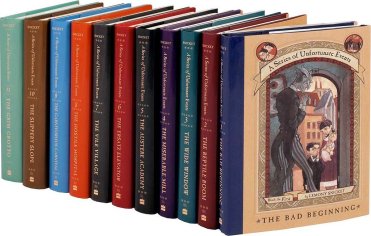
How did he even write so many?!

How did Lemony Snicket even write so many books on one topic?!

And even though I’m only 2500 words into writing the sequel, I find myself having to search through book #1 to make sure things are consistent. Did I use kilometers or miles as measurement? Has Character A ever met Character B before? Have I already used this metaphor to describe this situation?

But ultimately: how do I stop this sequel (and inevitably other sequels) from becoming stale? I guess I’m just worried the story won’t be exciting. For me, a new idea is everything. I fall in love, I become obsessed, I get on this high of a new manuscript. But with a book #2, that newness is gone. It’s like revisiting an old friend. What will we even talk about?!

Anyway, enough rambling. These are just some thoughts on my writing life for this hot afternoon, I guess.

Have you ever attempted a sequel or a prequel? What are your worries? Do you find writing the second (or third, or fourth) as exciting as writing the first book?

How to Be a Successful Writer

So, you wanna be a writer, huh?

Well, it takes a lot more than just saying so. In fact, one of the most annoying things you can say to a writer is, “I wanna write a novel too, but I…”

And there you go. Insert some excuse as if us writers have somehow been able to get out of things that would keep regular people from attempting a novel or a collection of poetry or short stories. The excuses range from lack of time to lack of inspiration, from not having anything to say to having too much to say (see my post called “Why I’d Rather Pass a Kidney Stone than Talk about my Writing” where I delve into this phrase further).

But outside of the excuses, what does it take to be a successful writer? Check out these 7 basics you need to master to become a successful writer.

Is this you? Do you *want* it to be you?

Is this you? Do you *want* it to be you?

What *is* Success?

The word writer, at its simplest definition, means someone who writes. Full stop. But that’s not much to go on, is it?

Technically, anyone can be a writer, and the word is flexible enough to cover a whole range of possibilities: a writer is someone who writes a blog, a writer is someone who writes TV scripts or novels, a writer is someone who writes business reports or those fun little anecdotes at the back of cereal boxes. Lastly, a writer is someone who toils away in their spare time, crafting a collection of words to convey an overall meaning. In theory, unpublished amateurs are also writers.

So, now that we’ve determined that you’re probably a writer (or a potential writer), what does it mean to be a successful writer?

Well, like the definition of writer, the definition of success is equally as fluid. Does success mean simply seeing your work in print? Does success mean becoming a New York Times bestselling author? Does success mean making a livable income off of your work?

Only after deciding what success means to you can you start working toward your goal.

You Must Actually Write

So, you’re a writer now? You’ve decided how you will define success, and you’re ready to go all in. Bad news #1: deciding to write was the easy part.

To be a writer, you must actually write. To have a completed manuscript or poem or article, you need to write it first. And then you need to rewrite it. And then you need to edit it. Writing, like anything, takes work. A lot of work. And the process will be very thankless. I wrote for 8 years without anyone giving a damn, and the only reason I’m here today with my debut novel published is because I was persistent.

You must be persistent too, but that means putting in the time.

Which Witch is Which?

Congrats on *actually* starting to write, and welcome to the land of fruitless labor, blood, sweat, and… paper cuts?

You have now realized that you need to actually put words on the page (or your arm in a pinch), and that’s great, but that’s not enough. How are you at spelling and grammar? Good spelling and grammar is the cornerstone of good writing, and there’s nothing more embarrassing than finding typos in your published work (I may be speaking from personal experience).

Got grammar sorted out? Cool. On to the next thing: how about pacing? How about character development? How about writing a good plot? Writing is so much more than putting words together in a grammatical sense. It’s about creating an atmosphere.

Be Unique, but Be Involved

The hardest thing to do in any industry is to be innovative and unique. Everything has been done before to some extent. I repeat: everything. BUT! That doesn’t mean you can’t put a new spin on old ideas or concepts. That doesn’t mean you should write stereotypical drivel.

At the same time, however, don’t risk alienating yourself and your work to be unique. Don’t write according to trends, but know what trends are out there. Don’t copy the greats, but at least read them and understand *why* they are great. You need to be involved in the writing community in some way, and for the love of Reese’s Pieces, read a book every once in a while.

Understand that Writing is a Business

I hate to break it to you, but the writing industry involves money. Sure, you write for yourself. Sure, you do it because you love it. But guess what? If you want to be successful, you need to come to terms with the fact that you’re writing for an audience.

There is money involved with successful writing careers. It isn’t always a lot of money, but it’s there nonetheless. There are parts of the industry that exclude art completely, instead focusing on sell-ability and marketing and numbers. And if you choose writing as your day job (one where you write articles or other non-fiction content instead of fiction), understand that this involves writing things you might not always want to write. It involves adhering to style guides. It involves business.

That said, if you want writing to be your business, never write for free. Sure, gaining experience is great, but know what you can offer and refuse to have your work undervalued.

Use Your Voice

Developing voice is perhaps the hardest thing for a writer to do. Trust me, I know this from experience. Conquering grammar and spelling is relatively simple, albeit annoying (Further? Farther? I’m over it), but voice is not something you can read up on and then regurgitate the next time you sit down to work on your latest piece.

Unfortunately, developing your voice simply comes with time. After plugging away at almost 220,000 words across three different manuscripts, I finally reached a point about two years ago where I said, “aha! I’ve found my voice”. But I’m not lying. It took six years and 220,000 words.

To Be an Artist is to Fail…

I’ve saved this point for last for one simple reason: the decision to write should be inspiring. You should be inspired to commit to daily or weekly word counts. You should be inspired to learn the ins and outs of grammar. You should be inspired to develop your own unique voice.

However, like all other professions within the arts industry, being a writer is an acceptance of failure. You will fail at some point. You will have your work rejected. You will have it chewed up and spit back in your face. You will face the fact that, at the beginning (inherently), no one cares. Seriously, I see many an amateur writer crumble and spiral into depression because they’ve come to the realization that no one cares about their work.

But embrace it. Work hard so that eventually (and I mean far-away eventually) someone will care. Sure, failure is guaranteed, but in order to be a successful writer, you need to be persistent. The only way to be persistent is to write because you love it.

Do you have any tips on being a successful writer?

How to Write a Novel that Will ACTUALLY Be Worthy of Publishing

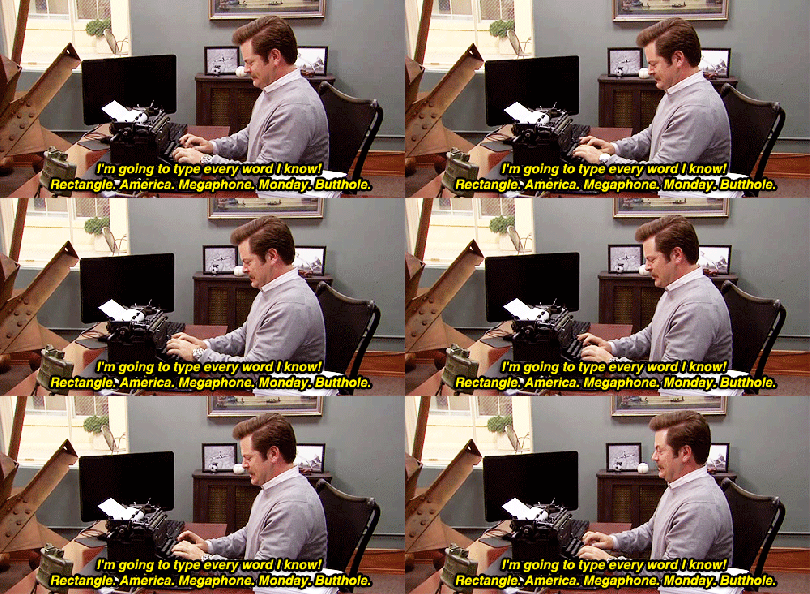
Ron-Swanson-Every-Word-I-Know

So, you say you have a dream, Mr. Martin Luther King Jr. of prospective fiction (or nonfiction) writer. Well, so do I, and so do millions of others around the world. That is to write a book, but not just any damn book: a book that will be good enough to publish.

Seems like a pretty simple goal, right? In today’s day and age, there are a billion ways to see your work published: paperback, hardcover, ebook, literary magazine, traditional publishing, self-publishing, hybrid publishing, serialization, writing your novel on your arm and reciting it in the subway (okay, maybe not that one…)

Since publishing a book is easier and more accessible than ever before, it’s important to know how to write a novel that’s worthy of being published.

Read Widely

“This is a given,” you say. This is what got you into wanting to write the most epic, mind-shattering, life-changing fiction in the world in the first place. It’s amazing though how quickly reading gets shut out of life after a 9-to-5 job, commuting, cooking, cleaning, sleeping, and meeting word counts consumes all your time.

Trust me, I’m guilty of putting reading at the bottom of my priority list. I find it hard to find time to read, but it really is necessary for a successful writing career. Reading allows writers to become fluent in their craft. It allows us to see what works for other authors, and what could work for us. It allows us to stay on top of what’s happening in the publishing industry and to analyze those happenings and apply them to our own career.

And you MUST read widely. Don’t only read the genre you write. It’s tempting to say, “Oh, well, I only write fantasy, so I’ll read myself silly with George R. R. Martin and J. R. R. Tolkien and Terry Pratchett”. Read everything. Read contemporary and young adult and romance and how-to manuals about square dancing and cat-sitting.

The classics are also a must — and believe me when I say that you won’t detest them as much as you did when you were forced to enjoy them in high school.

Learn How to Write & Edit Like Mad

Writing without knowing anything about the craft is like scuba diving without an air tank. It’s like running a marathon without proper shoes. It’s like driving a car with your eyes closed (which I do not recommend, to be clear).

You need to invest something into your writing, and I don’t mean that you have to toil and toil over plot points and character development and 100,000 cat videos on YouTube (though, that’s all included). You’re going to need to get control of your grammar and the conventions of your genre. You should invest in a style guide and maybe even read a few how-to‘s and don’t-do‘s. There are millions of resources online and at your local bookstore, and if your interested in improving your craft, I’ve already written a post with tips.

Even when you’ve mastered all those semi-colons and romance novel tropes and Oxford commas, you must still edit. All manuscripts go through a revision process, sometimes upwards of ten times, and if self-publishing is the right route for you, it is ESSENTIAL that you hire a professional editor to prepare your work for publication. There’s nothing more terrible than a novel that has grammar, spelling, and plotting issues (except maybe driving with your eyes closed).

Don’t Follow Trends

Are vampires and zombies cool anymore? No, it’s dystopian fiction and Fifty Shades of Too-Embarrassed-to-Be-Caught-Reading? Well, then.

Following trends doesn’t work. By the time you write something that follows a trend, polish it, and publish it, chances are that trend will be on the way out or already gone. Besides, it’s even worse when a writer writes something in order to try to capitalize on the bee’s-knees-du-jour, and it’s so blatantly obvious that they did that they write garbage. These novels lack originality and personality.

So, screw the trends. Write something that feels right for you, and maybe you’ll grandfather (or grandmother) your own trend. Talk about mind-shattering!

Know When It’s Crap

Ah, my USB. It’s a place where all the magic happens — and also the place where manuscripts go to DIE! Truth be told, not all of you work is meant to be published. Sometimes we write something full of cliches and plot holes and enough literary conventions to make Shakespeare hiss in territorial protection.

And that’s okay! You’re allowed to write crappy every once in a while. I did it. I have a manuscript that’s been edited multiple times but is now enjoying retirement in my “Nice Try” folder. I even have a nice disclaimer on the front page that says “In the event of my death, DO NOT publish posthumously”. It’s that crappy.

How do you know when it’s time to let go?

  • You’ve Lost Interest. That initial spark is gone, and writing the piece feels like drinking three-week-old urine with ground up ceramic. Yeah, that feeling.
  • You’ve Written Yourself into a Hole. This is the hardest time to let go. This happens when your plot is so mangled that it’s unrecognizable. It’s unfocused and messy, inconsistent and terrible. Sure, you could edit, but is it worth it? Maybe let it be for a while and come back later.
  • You’re Not Ready. We all need the opportunity to fail. Sometimes what you write is just the trial edition. You can’t run a marathon without training. You need some practice runs, so to speak. It’s important to know when you’re writing a practice run, especially if you’re just starting out and writing your first novel.

How do you know when something you’ve written is worthy of publication? Do we ever really know?