Tag Archives: writing

5 Tips to Writing a Successful First Draft (Even if it Sucks)

To date, I’ve completed 4.5 first drafts. I say 4.5 because I have 4 manuscripts of novels that are at various points of editing and publishing, but I also have a fifth manuscript, a contemporary YA that’s on vacation. I say vacation because it’s nicer than saying on hiatus or abandoned or acknowledging that I *may* not be ready to complete it yet.

In any case, writing a first draft is a complicated and emotional process. It’s complicated because you don’t know what you’ll end up with once you start. It’s emotional because of how invested you become: in the story, in the characters, in the frustration that the “art” you’re creating may be nothing more than a carefully-crafted piece of crap.

But worry not: all great literature had to start off as crud. In fact, all those bestsellers you admire yet secretly envy on your bookshelf were probably rejected multiple times.

So check out these 5 tips for completing your heap of crap!

Plan — Or Don’t!

Some writers are planners. Some writers are not. I am a hybrid of the two: I start off by letting things just happen, and then I start to outline, flesh out characters, and plan scenes. I’m a like a liger, if you will. Magic and all.

liger-2

It’s up to each writer to determine what works best for them. Planning can help focus a story, but it can also sap it dry of all its intrigue and leave the writer uninspired to get it finished. I find that when I plan too intensely or too early, this happens to me. Remember that vacation my .5 was on? Yeah… I planned too early. It’s like all the magic is gone, and writing it feels like homework. When that happens, it’s best I back away for some time.

But some writers are the opposite. If they have no plan, they have nothing to hold them to their goal of writing a novel. There are a number of methods out there including chapter-by-chapter breakdowns, pre-completion synopsis writing, and the Snowflake MethodChuck Wendig has a great list of methods to plan your novel.

Don’t Edit

Seriously. DON’T. Put down your red pen. Editing is the kryptonite of writing a first draft. I never do it unless I want to end up in the oblivion of perfection-seeking and aimless toiling. The number one way to self-sabotage your work is by primping and probing too soon. It’s like taking a baby out of their crib, plopping them in the driver seat of a car, and expecting them to win the Indy 500. It will be disastrous simply because they’re not ready.

The same is true for your novel. Your first draft is the infancy of your novel, and should you helicopter-parent too soon, you will experience an adolescence of bad attitude, screaming matches, and underage drinking. You need to give your first draft some space to breathe. Allow yourself to be creative and get your ideas down before you start picking and pulling it apart.

Just Keep Swimming

When it comes to writing a first draft, perseverance is key. It’s easy to entertain an idea, to write the first ten pages of a piece, to daydream about characters and betrayals and plot twists. Heck, it’s fun even! But when the novelty wears off, the only thing that will see you through the middle-manuscript blahs will be your determination to get that sucker finished.

For me, weekly writing goals work. Do I always stick to them? Haha… no. This last week alone I had a writing goal of 2500, and I only made 1600. But, you see, even though I didn’t make my writing goal, I still wrote. I still persevered. I am still determined to complete my manuscript. In fact, my writing goals are more like guidelines. 1600 words is better than none at all, and if I make even half my goal of 2500 words this week, that is 3000 words closer to a completed first draft.

Allow Yourself to Suck

You suck. I suck. Everyone sucks.

Seriously, the first draft sucks. There’s no getting around it. There’s no way to sacrifice a lamb to the demi-gods of the Sahara and write a perfect first draft (but if there is, hook a brother up!). So come to terms with it. Digest it, and make it part of your writing routine. Allow yourself to suck, and writing your first draft will go smoother, I promise.

In fact, once you liberate yourself, you may find that you don’t suck as much as you feared after all.

Expect to Rewrite

If you haven’t realized this by now, I’m sorry to break this to you: your first draft is NEVER the one you show the world. Wallow in self-pity now, aspiring writer, because if you want this, you’re in for the long haul. Even if you manage to nab an agent or an editor off of your first draft alone, they will insist you edit. In fact, my first novel has gone through 12 edits, and it hasn’t even been released yet.

But this isn’t a terrible thing. Your first draft is crap, remember? The only way to make it into gold is by editing. Essentially, the first draft is only half of the task of writing. Editing is where you get to show the reader your storytelling prowess and wow them with your spit-shined, immaculately-constructed prose.

How do you get through a first draft?

5 Ways to Stretch Your Word Count

writing

This time last year, I thought my newest New Adult speculative fiction work-in-progress about the collective subconscious and evil corporations was finished and ready for the world. Since then, I have gotten sidetracked by the release of my first novel entitled The Black Oracle and by the launching of my full-time writing career. During all this time, I have been on a steep learning curve, growing exponentially in the world of writing, publishing, and editing. It wasn’t until I *actually* went to prepare my New Adult speculative fiction novel for publication that I realized I had a problem: the word count of 50,000 words was too short.

Now, I know what you’re thinking. In fact, I’ve already heard it from my critique partner. “When your novel is done, it’s done“. That is to say that once a piece is finished from beginning to end, and it has been edited to the point of being ready for publication, it’s silly to go back. It is what it is, so to speak, even if it is a little short.

But that didn’t stop me from doing research. In fact, Literary Rejections has a fantastic post about standard word counts for all genres, and they peg the average for New Adult at between 60,000 and 80,000 words. “Be the rule, not the exception,” they advise.

And whether or not writers want to admit it, word counts count, and editors and agents judge you on them every. single. day.

So that’s when I decided to pump 10,000 to 15,000 new words into my New Adult speculative fiction novel. Currently, I’m trudging through it, daily word count goals slowly driving me insane. It isn’t easy to add more words to a novel that I thought was finished. I needed a plan. Luckily, I was able to find 5 tricks that help to stretch word counts without adding mindless filler and unproductive storytelling.

Explore Backstory

For me, this is going to be one of the best ways to gain a few thousand words. Writers spend a lot of time fleshing out a character’s past experiences and thinking about how those experiences lead them to their actions within the story. The problem: much of this backstory stays with the author. These character sketches don’t always make it to the finished product.

But why not? Why not make those experiences available to the reader?

Write a good flashback. Have a character tell a story about a past event. Have your main character reflect back on a past event. There are many ways to weave backstory into your plot without writing entirely new scenes and without info-dumping, and doing so is a great way to increase your word count.

Slow Down the Pacing

I must admit, I am a fast-paced sort of writer. I don’t like writing filler scenes, and I don’t like taking my time. I want the action to happen, and I want all my storytelling to be as productive as it can possibly be.

Downside: I write shorter manuscripts. It’s not a crime since some of the bestselling books of all time have been short, but it definitely makes me a touch insecure when I read about word count expectations. So when writing, I try to keep mind to slow my pacing. One of the techniques I use is to plan out my scenes before I write them. Without a plan, I could probably write an entire novel in ten pages (a crappy novel, no doubt).

Secondly, I aim to slow my pacing through my word choices and sentence structures. We live in a society where a lot of description in prose is frowned upon, and though I don’t go all Tolkein-esque and spend pages upon pages detailing trees and rocks, I use my sentences to better flesh out ideas and settings. A longer word count is just a happy by-product of that process.

Develop Your Characters

One-dimensional characters are often the death of a potentially great novel. No one likes to read a character that has no goals, no genuine emotion, no life. The best ways to develop your characters are to give us access to their thoughts and dreams, give them a backstory (see above), and give them reasons for being in your story.

Again, by-product: all of this character development takes a time, thus stretching your word count.

Write a Subplot

This is my favorite word count stretching technique. I love subplots. LOVE. I would write an entire novel of subplots if I could. There’s so much freedom in taking a character and developing their actions into a quasi-separate story. And then when the subplot mixes and mingles with the main plot? Gold. GOLD, I TELL YOU.

Check out this cool post on the different types of subplot and how they can seriously enrich and advance your story.

Make Things Complicated

Last but not least, stay away from easy. This technique sounds like a given, but believe it or not, a lot of authors fail to make their stories complicated and thus interesting. Some stick to the A-event + B-event = Conclusion model, and this is terribly boring.

Give your reader something more. Add additional events to your plot-development equation, ones that make the main character work for their reward. If the story is straightforward and predictable, the reader will also find it straightforward and predictable. Add some uncertainty. Add some misunderstanding. Add some betrayal.

All of this will help to enrich your story and yes, stretch your word count.

Got any techniques for increasing your word count? Do you even bother to try to meet industry or self-imposed word count standards?

Authors for Indies Day!

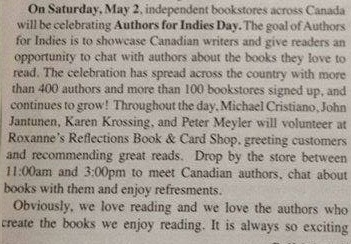
As some of you may or may not know, I am doing my very first promotional event for The Black Oracle two weeks from now. I am going to be at Roxanne’s Reflections Book and Card Shop in Fergus, Ontario on Saturday, May 2, 2015. The occasion? It’s Canadian Authors for Indies Day!

Look, Ma, I'm in the newspaper. #basicallyfamous

Look, Ma, I’m in the newspaper. #basicallyfamous

Authors all across Canada will be in independent bookstores on this day to volunteer and promote indie publishing and book selling. Why not volunteer at a chain bookstore? Independent bookstores offer a great alternative to mainstream, multi-location stores. They provide welcoming atmospheres, caring employees and owners, and best of all, they allow for a wider selection of books than other corporate giants. Independent bookstores are often the first to open their doors to independent authors — something that big chain booksellers make it hard to do unless you have a major publisher and distributor.

So, naturally, when my publisher Curiosity Quills Press suggested I team up with a bookstore for this awesome day, I jumped at the opportunity. Independent bookstores have been a huge part of my book-loving and writerly life. Since I was young, my parents have taken me to cottages every summer. We cottaged along the Trent River, on Lake Eugenia, and about five years ago, my parents fulfilled their dream of buying a cottage near Belwood Lake.

My favourite thing about cottaging is the lack of distractions. I could hang out on the patio for hours on end with very limited cellphone service, absolutely no internet, and a book in hand. The best part: I got to explore the towns nearby, ones with a good independent bookstore or two. When my parents settled near Belwood Lake, some of my favourite days were spent exploring Fergus. That’s when I discovered Roxanne’s.

Little did I know at the time, Roxanne’s Reflections is a community favourite. Roxanne and her staff are friendly and helpful, and always striving to find readers the perfect book. I’ll never forget when the film adaptation of The Great Gatsby came out a couple summers ago, I wandered into Roxanne’s looking for a copy. I’d read in in high school and hated it (I know: how silly of me!), but Roxanne had a huge selection of special edition copies, and I bought one and consumed its contents all in one day.

I guess what I’m trying to say is that independent bookstores like Roxanne’s Reflections really care. It’s easy to walk into a chain bookstore, get overwhelmed by the endless tables of supposed hot fiction, and then encounter a staff member who may not know Aldous Huxley if he walked in and smacked said employee in the face.

So, this May 2, head out to an independent bookstore and show your love even if you do not reside in Canada. If you’re in the Fergus area, drop by Roxanne’s between 1 pm and 3 pm. I’ll be there then, but it is an all day event. Otherwise, check out Authors for Indies website for a location near you. Who knows, you may just encounter Guy Gavriel Kay!

9 Tips to Improve Your Writing

One of the hardest things about being a writer is knowing when you’ve reached that elusive status of being a good writer. Scratch that: the hardest thing about being a writer is knowing when you no longer suck.

You see, bad writing is everywhere nowadays. With the exploding self-publishing industry, anyone can become a published author. Anyone. Have good books been self-published? Of course, but bad books have been published tenfold, and this excludes all the times that a big press has released a poorly written book (in the name of business, of course).

So, how do you avoid being a bad writer? Well, the answer is simple: hard work. And while you’re at it, pounding away at your keyboard and going for that eighth cup of coffee, incorporate these tips.

coffee

Yeah, I’d go put the pot back on. You might be here a while.

Write Often and Diversify

A writer who doesn’t write is a person who is just… well, a person. To be a writer, you must write. Yes, that means you must sit down with notebook and pen, keyboard and screen, arm and permanent market, and create something. But you mustn’t only strive to write as often as you can. You should experiment with differently genres and mediums to see what works best for you. If you’re a poet, try a short story. If you’re a novelist, try articles or essays. There are so many ways writers can practice and hone their craft (freelance writing, blogs, social media), and there’s a seemingly endless stream of topics to write about.

Read. EVERYTHING.

Just because you’re a science fiction writer, it doesn’t mean you should only read science fiction. Just because your a short story guru, it doesn’t mean you shouldn’t pick up poetry. You should read things you would never think to read, and the classics of each medium are a must. Don’t only stick forget nonfiction and media though. Read newspapers, online journalism, blogs, the backs of cereal boxes. The more you immerse yourself in writing, the more natural it becomes — and the mind has a way of imitating things it likes.

Subscribe to a Style Guide

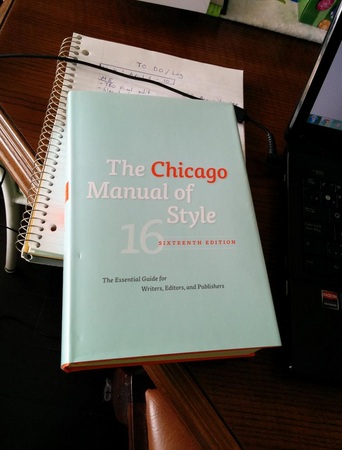
I know, I know. Why would you want to buy something that reads like a grammar textbook? Yes, I’m aware that writing is an art, but you also must realize that this art has rules. Buying a style guide is a way of learning about those rules. I like the Chicago Manual of Style, mainly because it is the predominant style guide in North America, but there are loads of others. If it is your dream to write professionally, whether it be fiction, freelance, or nonfiction, you should get yourself  style guide. Regardless of which guide you subscribe to, the key is to be consistent.

Look at how pretty it is!

Look at how pretty it is!

Use Prompts and Exercises

I’m not big into writing prompts, but I do admit, they’ve gotten me a few cool ideas. Do a quick Google search, and you’ll see that there are hundreds, nay, THOUSANDS of prompts to get you in the mood (not that mood). I’m all about those writing exercises though. Whenever I’m trying to get a new idea, I love a good free write. Whenever I’m trying to flesh that idea out, I make mind maps and pretend conversations with my characters. Exercises and prompts are also good ways to counter that writer’s block.

Focus on Openers

There’s a reason why openers are called hooks. The purpose of the opener is to entice your reader, pull them in, and then trap them so they won’t think to run until it’s far too late. From my experience as an Acquisitions Editor, I reject a lot of work because of weak openers. Put simply: I reject things I’m not excited to continue reading. It doesn’t matter if your middle is spit-shined, bacon-wrapped, chocolate-dipped literary gold. No one will get to it if you don’t give them a reason to hang around.

Do Things that Inspire You

Sitting around the house all day won’t inspire you enough to be excited about your writing. Well, it might, but you might also find you need something more. Travel, discover your city, visit museums and art galleries and after hours nightclubs (creeper protection not included). Don’t be afraid to do things out of your normal because it’s in these situations where we grow. Besides, new experiences are always great sources for writing material.

Find a Friend

Writers need criticism. Do they always want it? No, but after a while, a writer realizes that the best way to grow is to embrace criticism and STOP writing it off as useless hatred (haha, see what I did there?). I’m serious. Go find a writing partner, ideally someone who reads a lot and perhaps writes quite a bit too. Most importantly, you want this person to be honest with you. You want them to give you notes about what they don’t like and what needs to change, and you need to TAKE THEIR CRITICISM AND USE IT. Is all of it useful? No. Some of it, you may veto (I’ve done so from time to time). But if you’re ignoring 95% of all the criticism you receive, the problem *may* not be your writing partner.

Edit Ruthlessly

Whether you have a writing partner or not, a first draft is NEVER an acceptable manuscript. You should cut things. You should add things. You should eliminate all cliches, most adverbs, and flowery prose from your work. Once you think you’re done, take some space. Give yourself a week or two, and return to hack away some more. It’s not over until you’ve mistakenly cut off a limb.

Wait, you’re not done. Remember the style guide we spoke about? Go read it. Brush up on your grammar, go back, and copy edit the crap out of your work.

Don’t Try So Hard

My final piece of advice is quite simple: don’t try so hard. Revel in the simplicity. Be concise, and say what you mean. I’m sorry to tell you, you will not be another Hemingway. Before you sulk, you will not be another Hemingway because there is only ONE Hemingway (and spoiler alert: he’s dead). But you’re you! Isn’t that enough? Take pointers from the greats, but don’t steal their style. Yours may still be a ways away, but it’ll come.

But leave out those damn adverbs.

Why Write?

So, I read an interesting blog post yesterday by the fantastic Kristen Lamb (follow her. NOW!), and she addressed the idea that only 5% of prospective writers *actually* become successful authors. In her post, she argued that although this is a depressing statistic for those of us who aspire to be that elusive successful writer, 5% isn’t that bad. Check out her reasoning:

When I gave the 5% statistic earlier, many of you were probably discouraged. But let’s take a closer look at that number.

It’s been said that as much as 75% of the literate population would love to one day write a book. Out of hundreds of millions of possible authors, how many do you think actually take the idea seriously?

5%

And of the tens of millions left over, how many sit down and write and finish a first draft?

5%

Of the millions remaining, how many actually read craft books, get critique and keep revising that first draft until they have a polished draft?

5%

Of those who finish that first novel then realize they have a train wreck and not a novel, how many suck it up and start over to write a better book that’s more likely to engage with readers?

5%

Of those who finally write a decent book, how many take time to also build a brand and platform? How many learn to blog effectively in ways that reach and cultivate readers?

5%

How many get in the regular habit of writing, researching and revising? They don’t just stop with the one book and keep on writing more books?

5%

Of those who publish the first book and don’t instantly become zillionaires, how many keep writing and improving?

5%

This profession is really hard. Toss a few hundred million people with a dream into one large funnel and most will not shake out at the end. Yet, if we look at the individual pieces of becoming “successful” it is astonishing how much we control.

Others whine, we work.

At this point of my life, I found this to be pretty inspiring. I recently left my 9-to-5 (read: my contract didn’t get extended), and though I wasn’t completely against going out and finding another one, I’m *kinda* inspired to give this full-time writer thing a try. So, that’s what I’ve pledged to do. I have my novel coming out next month, and I’m working to secure some freelance work. Is this plan risky? Of course. Am I worried? Not really.

In light of these things, Kristen Lamb’s reasoning got me thinking. Yes, 5% may not be so bad when you consider that a lot of unsuccessful writers  are unsuccessful because they don’t put in the time, but the amount of commitment expected of a writer is nothing to laugh at. In fact, becoming a writer is often fruitless labor for the first while (10 years in my case), so with that seemingly unattainable dedication, why write at all?

I think the answer to that question is fairly simple. Anybody who is serious about writing already knows that answer, and I think it is those people who end up persevering and becoming the perceived unattainable successful writer. The fact is that writers write because they have to. They write because there isn’t anything else they’d rather be doing. They were “born this way”, so to speak (Thanks GaGa). And at the end of the day, a writer becomes one of the “lucky” 5% not because of luck at all but because they wanted to, and they worked their butt off to get there. I’ve always said that becoming a writer is like running a marathon: you don’t just wake up one day, show up at the starting line, and come in first place. There’s training. There’s failure. There are nasty blisters and early mornings and vomiting from overexertion (beautiful visual, Michael).

But writers like it this way. If becoming a successful writer were easy, it wouldn’t be worth it. How fulfilling would it be if you could just laser beam 80,000 words onto a computer screen and then sell it to the first publisher you pitched it to? Not very.

So, take comfort in the fact that determination does great things. Work your butt off, but enjoy the process. It’s not until years later that you appreciate all the time it took you to grow. Trust me, reading old material has become a nice pastime for me. It’s kind of inspiring.

Why do you write? Do you worry about becoming a successful writer?

Cover Reveal for The Black Oracle!

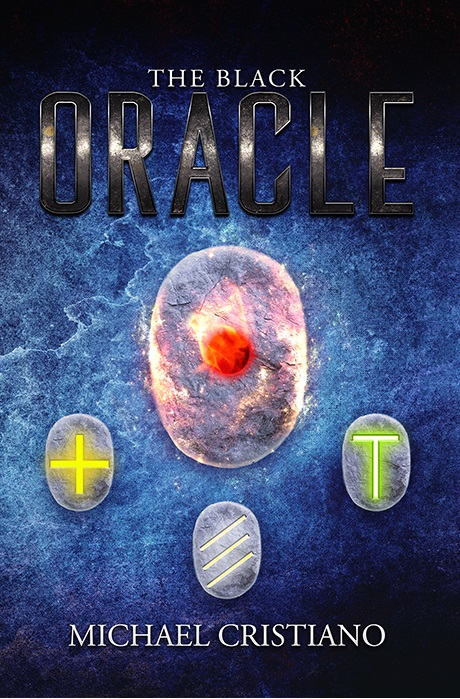
I’m happy to announce that today is the cover reveal for my novel The Black Oracle!

So, without further ado, check it out!

The_Black_Oracle_Cover

Publisher: Curiosity Quills Press
Release Date: May 25, 2015
Cover Art: Alexandria N. Thompson

On a post-apocalyptic Earth, humans are not alone.

Joachim is a hunter. Though generations have passed since the Great Death, something has evolved in the trees beyond the giant glowing mushrooms, mutants that want to see human entrails spread along the jungle floor.

And now they’ve taken Joachim’s wife.

To get her back, Joachim will have to give the leader of these demons something in return: immortality. A creature knows when he is going to die, after all. Plunged into a world of magic and darkness, Joachim must find the only woman who knows where the ingredients are. She is a prophetess known as the Black Oracle living in the realm of Zalm, but she’s a little preoccupied at the moment. She leads a rebellion against the ruthless High Council, and when Joachim seeks her out, he too finds himself consumed by her struggle.

In a story of betrayal, prophecy, and bloodshed, Joachim has ten days to retrieve the ingredients and return to Earth all while evading the High Council’s army, one that wants the Black Oracle and her associates killed — Joachim included.

Add it to your to-read list on Goodreads!

——-

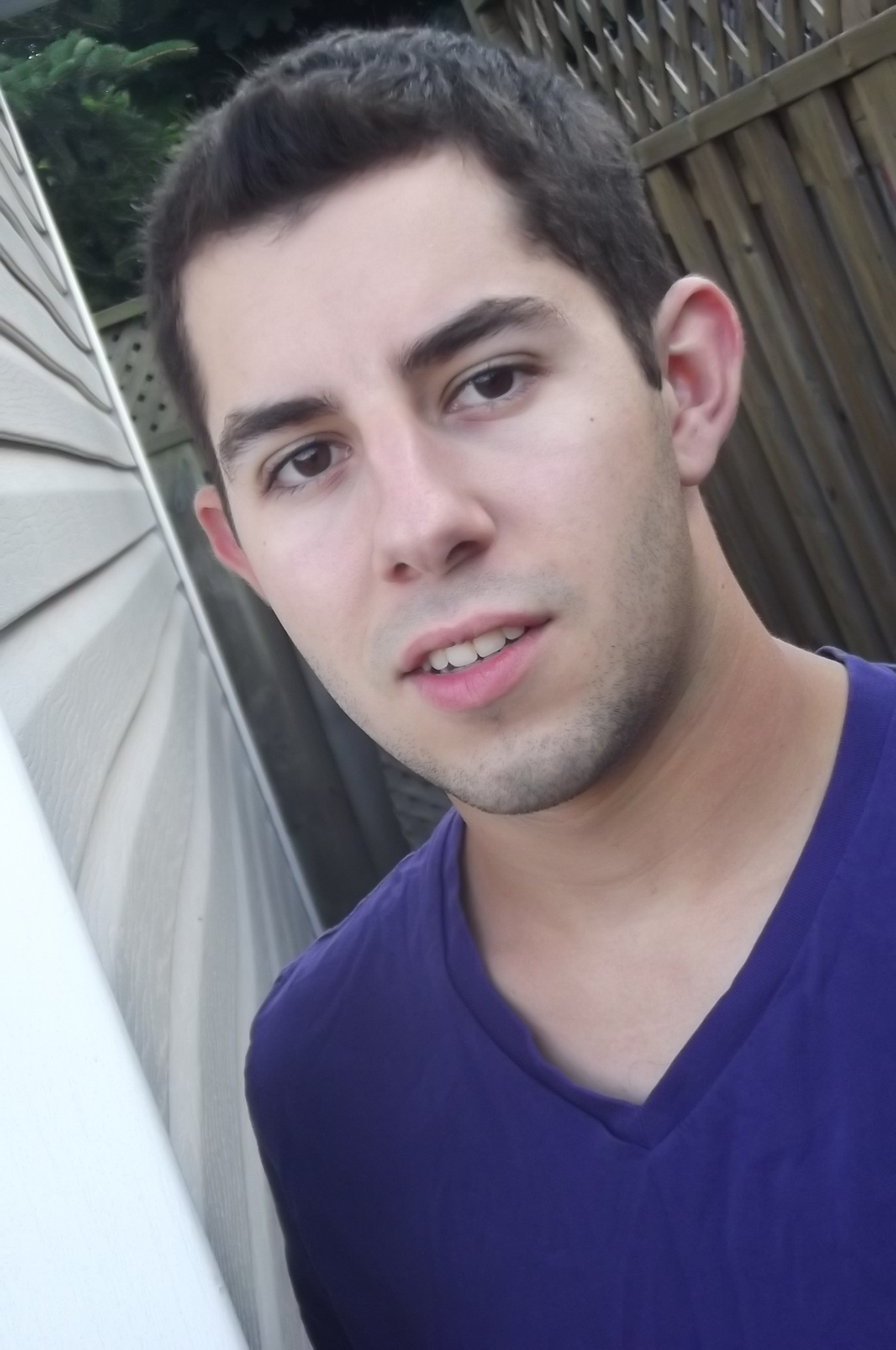
Bio_PictureMichael Cristiano is a Canadian writer. His relentless obsession with fiction began long before he could even spell the words ‘relentless obsession’. Growing up in endless suburban sprawl, he spent most of his childhood getting lost in fantastical masterpieces and attempting to be published by the age of thirteen.

When he isn’t writing or reading, he can be found planning his next backpacking trip around the world. He is a recent graduate from the University of Toronto with studies in Foreign Language and Linguistics. Previously, he attended a Regional Arts high school where he majored in drama. He is fond of all things dramatic.

Michael currently resides in the Greater Toronto Area and he is using his years as a twenty-something to establish what he hopes will be a long career in writing. The Black Oracle, his debut novel, is due for publication on May 25, 2015.

Website | Facebook | Twitter | Goodreads

I’m a Travel Writer!

Just a quick post to announce that I am officially a travel writer with nexopia.com! I will be writing two to three articles a week about backpacking, tourism, and all things travel. You can check out my first post here where I discuss slum tourism and the morals behind the questionable practice.

Also, the cover reveal for The Black Oracle is on Saturday, so stay tuned for that also!

You Can Only Write One Genre for the Rest of Your Writerly Life!

As a writer, the last thing I want to do is restrict myself. Yes, it’s true, there are genres that I will never write (erotica, true crime, nonfiction textbooks on astrophysics), but other than that, I’m open to pretty much anything. I love straddling the line between genres, often bridging fantasy, science fiction, and paranormal and then throwing in some literary flair.

So, imagine my surprise when I was told that I should pick and stick to one genre. My conversation went something like this:

Me: “My most recent work is a blend of fantasy and sci-fi, but I have ideas that venture into horror, paranormal, and even contemporary fiction.”

Acquaintance-With-Some-Writing-Experience: “Aren’t you worried?”

Me: “No. Why?”

Acquaintance-With-Some-Writing-Experience: “I learned in my creative writing courses that authors should stick to one genre. That way, they become really good at writing it, and they become specialized in that field.”

I’m not going to lie, I understand the logic, but I was taken aback. First of all, I haven’t taken many courses. I took a few in high school and one in university, but I didn’t major in creative writing (and I didn’t want to, but that’s for another post). Most of what I learned about writing was a trial and error of sorts: reading a lot, writing a lot (of crap, I might add), getting feedback from beta-readers.

But I was completely floored that a creative writing instructor would tell students that they had to pick one genre and only one genre, and any straying was literary suicide.

You must choose ONE pill that will seal your fate for all-- Oh, wrong post.

You must choose ONE pill that will seal your fate for all of — Oh, wrong post.

Needless to say, I disagreed with this conclusion vehemently. I didn’t really say what I was thinking, giving my acquaintance some response between apathy and “to each his own”. There’s nothing wrong with writing only one genre, but there are two fundamental problems with the argument my acquaintance presented. Observe.

Tastes Change

Writers, like all other human beings, are not static. If you had given me a salad 5 years ago, and you happened to put onions in it, I would have picked all of them out, avoiding them like they were hemlock or something. Now, however, I love onions. Put onions in EVERYTHING! I’m not even sorry for my stinky breath.

The same goes for writing. When I was younger, I loved Harry Potter. In fact, I loved it so much that I wanted to write a series about a school that taught the occult arts, and instead of wizards and witches, the students were known as little devils. Luckily, that idea didn’t last long, and as I read more, I grew to want to write more. Even now, I read more widely than ever: fantasy, science fiction, young adult, literary, horror. And ultimately, what kind of writer doesn’t get impacted by what they’re reading?

For me, diversifying is a form of improvement. By changing up what I read, I am exposed to different forms of writing, and trying them out helps me hone my craft. Is everything I produce good? Of course not, but if I’ve written something that I love and that I believe in, why should I deny it its chance to shine because it isn’t in the pre-determined genre I’ve chosen?

The Greats Don’t Always Stick with This Rule

After the Harry Potter series, JK Rowling wrote a contemporary drama and then a series of mystery novels under the name Robert Galbraith. Margaret Atwood is known for bending the rules and writing across genres, often spanning mystery, science fiction, and literary fiction. Do I think I’m on the same level as these greats? Well, no. But they’ve found success in multiple genres, so why can’t I?

Regardless of these two arguments, however, I think this solution to this issue comes down to one thing: where does your inspiration lie? There are many successful writers that stick to a single genre, and they do quite well. There are ALSO successful writers who write across genres. Do I think this has impacts on the quality of the writing itself? No. I think if a writer writes well enough, they can tackle any genre they’re passionate about.

What do you think? Are you a one genre kind of writer, or do you like traversing multiple ones?

The Black Oracle is Now on Goodreads

Hey everyone!

Just a quick post before I give my review of Kurt Vonnegut’s Slaughterhouse Five within the next few days. I am happy to announce that my debut novel, The Black Oracle, is now up on Goodreads. Further, I am ecstatic to finally say that it will be released on May 11, 2015!

Stay tuned for my cover reveal later this month and for ordering details, but for now, check it out and add it to your to-read list on Goodreads! I’ve attached a description of the novel below.

THE BLACK ORACLE

On a post-apocalyptic Earth, humans are not alone.

Joachim is a hunter. Though generations have passed since the Great Death, something has evolved in the trees beyond the giant glowing mushrooms, mutants that want to see human entrails spread along the jungle floor.

And now they’ve taken Joachim’s wife.

To get her back, Joachim will have to give the leader of these demons something in return: immortality. A creature knows when he is going to die, after all. Plunged into a world of magic and darkness, Joachim must find the only woman in who knows where the ingredients are. She is a prophetess known as the Black Oracle living in the realm of Zalm, but she’s a little preoccupied at the moment. She leads a rebellion against the ruthless High Council, and when Joachim seeks her out, he too finds himself consumed by her struggle.

In a story of betrayal, prophecy, and bloodshed, Joachim has ten days to retrieve the ingredients and return to Earth all while evading the High Council’s army, one that wants the Black Oracle and her associates killed — Joachim included.

Freedom 25! (Wherein I Divulge Some Cool News)

You’ve heard of Freedom 55, right? It refers to the idea that one can retire from work at the age of 55 instead of the more probable age of 65 (or older, depending on financial situations and pension). But what if I told you I was aiming for freedom at the age of 25? I’m 23 now, and 25 is in reality only one and a half years away, so have I lost my mind?!

Not really. I’m not looking to retire at the age of 25. Not only is it entirely NOT possible unless I win the lottery, but I’m not even sure if I could just stop being productive altogether (but sometimes it’s a nice thought though, isn’t it?)

For me, Freedom 25 means that I will be at a stage of my life when I am happy with where I’m at, what I’m doing professionally, and where I’m going at the time I am age 25. I’ve been struggling with this a bit lately, but I can finally say I’m on track. So, without further ado, I have something to announce.

Along with having my first novel The Black Oracle released in the spring (official release date to come!), I have also been taken on as an Acquisitions Editor by Curiosity Quills Press!

Starting within the next few days, I’ll be on the front lines tackling the slush pile and looking for gems that are suitable to be published. Curiosity Quills Press, publisher of my novel The Black Oracle, is a small hybrid press that specializes in everything from science fiction and fantasy to contemporary romance and everything in between. They’re a legitimate publisher (no reading fees), and my experience with them has been amazing! You can check out more information about them here.

But what does that mean for you? Well, if you have a finished manuscript and you’re looking to have it published, consider sending your query to me! You can do so by going to this website, reviewing the submission guidelines, filling out the webform, and marking the submission “For Michael Cristiano“. So, would your project interest me, you ask?

First and foremost, I like reading anything that’s good, and by good I mean well edited and well thought out and polished. I generally read fantasy, so that includes but is not limited to epic fantasy, magic realism, urban fantasy (I’d die for an awesome urban fantasy — think The City Trilogy by Darren Shan). I dabble in science fiction, especially dystopian and post-apocalyptic fiction. Some of my favourite sci-fi/fantasy authors include Patrick Rothfuss, Terry Goodkind,  JK Rowling, Suzanne Collins, and Lem0ny Snicket. I also like horror and paranormal novels, but I’m more into a slow creepy build than blood and guts and murderers. Not big on romance, but I am a fan of literary fiction — I adore Margaret Atwood, Aldous Huxley, George Orwell, and Kurt Vonnegut. As for age groups, I’m open to all age groups from upper middle grade to adult fiction (as per Curiosity Quills’ guidelines).

In doubt? Send it along. If it’s not something I’d read but I think the premise is good, I’ll send it to another Acquisitions Editor.

Happy weekend and happy writing, everyone!